
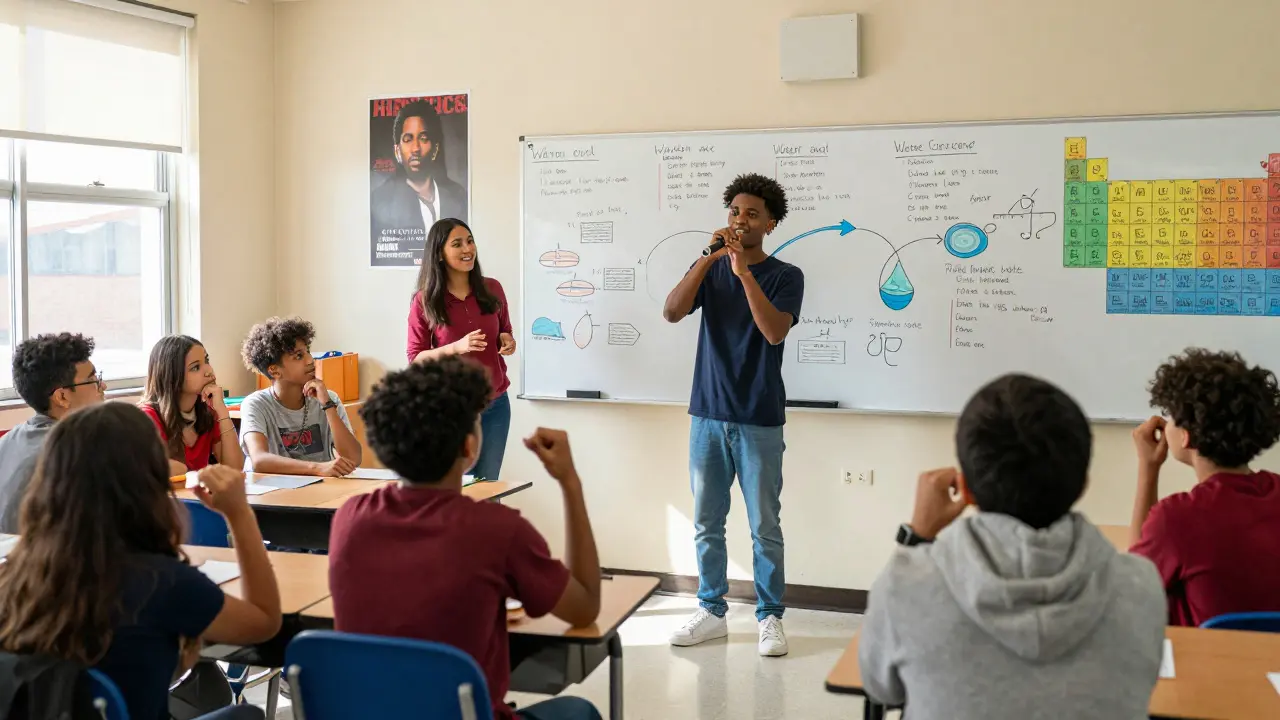
When you think of hip hop music, you probably picture booming bass, slick rhymes, and street culture. But in classrooms across the U.S., Australia, and beyond, hip hop is doing something quieter - and far more powerful - than any concert: it’s helping kids learn.
Teachers aren’t just playing rap songs for fun. They’re using hip hop as a tool to teach history, poetry, math, and even science. Students who zone out during lectures light up when a verse from Kendrick Lamar or Public Enemy opens a door to understanding systemic inequality. Kids who struggle to write essays suddenly craft complex lyrics about fractions or the water cycle. Hip hop isn’t just entertainment here - it’s a bridge.
Why Hip Hop Works in the Classroom
At its core, hip hop is storytelling. It’s rhythm, rhyme, and real talk. That’s why it connects so deeply with young people, especially those who feel disconnected from traditional teaching methods. A 2023 study from the University of Melbourne tracked 400 students aged 13-18 in low-income schools. Those exposed to hip hop-based lessons showed a 37% increase in reading comprehension and a 29% rise in class participation compared to peers in standard curriculum classes.
Why? Because hip hop speaks their language. It’s not about dumbing things down - it’s about meeting students where they are. A kid who knows every line from J. Cole’s "1985" can analyze metaphor, symbolism, and social critique better than they can with a textbook. When you tie algebra to the beat of a Nas verse or use Missy Elliott’s "Work It" to explain physics concepts like momentum and motion, learning stops feeling like a chore.
Real Lessons, Real Results
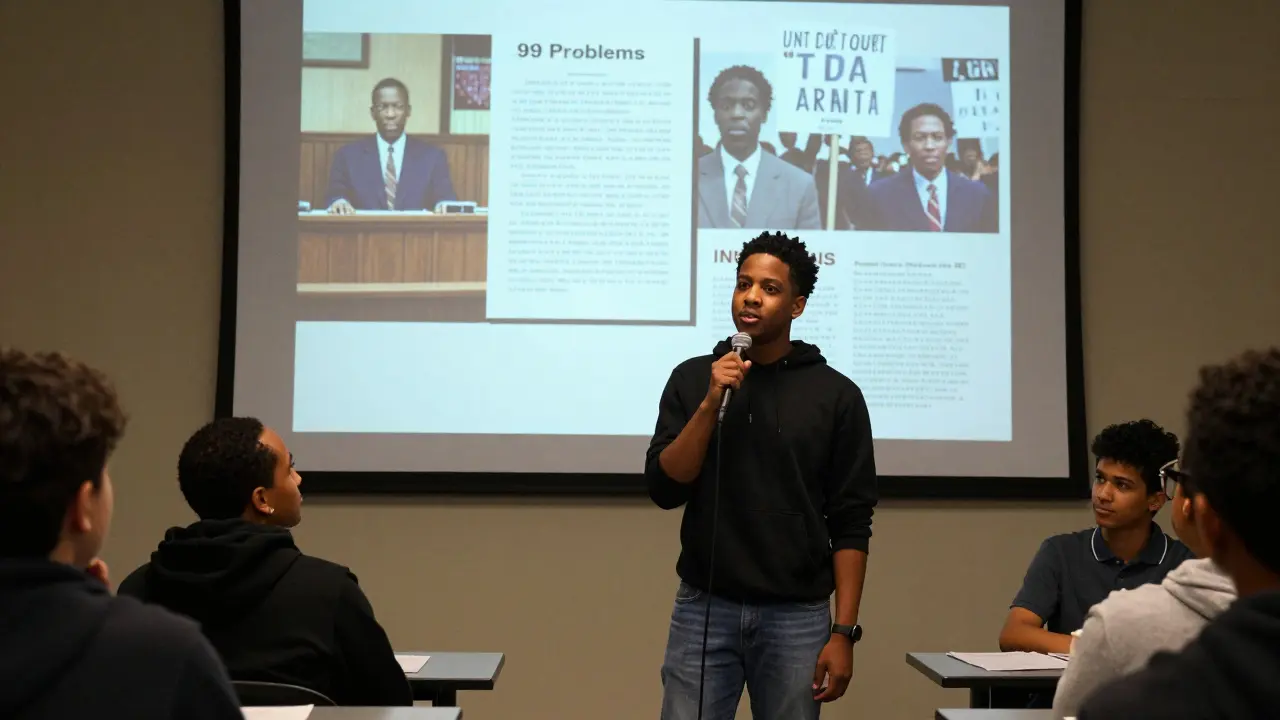
At Northside High in Atlanta, history teachers use Jay-Z’s "99 Problems" to teach the U.S. criminal justice system. Students break down the lyrics line by line, comparing them to real court cases, sentencing disparities, and policy changes since the 1990s. The result? Test scores on civil rights units jumped by 41% over two semesters.
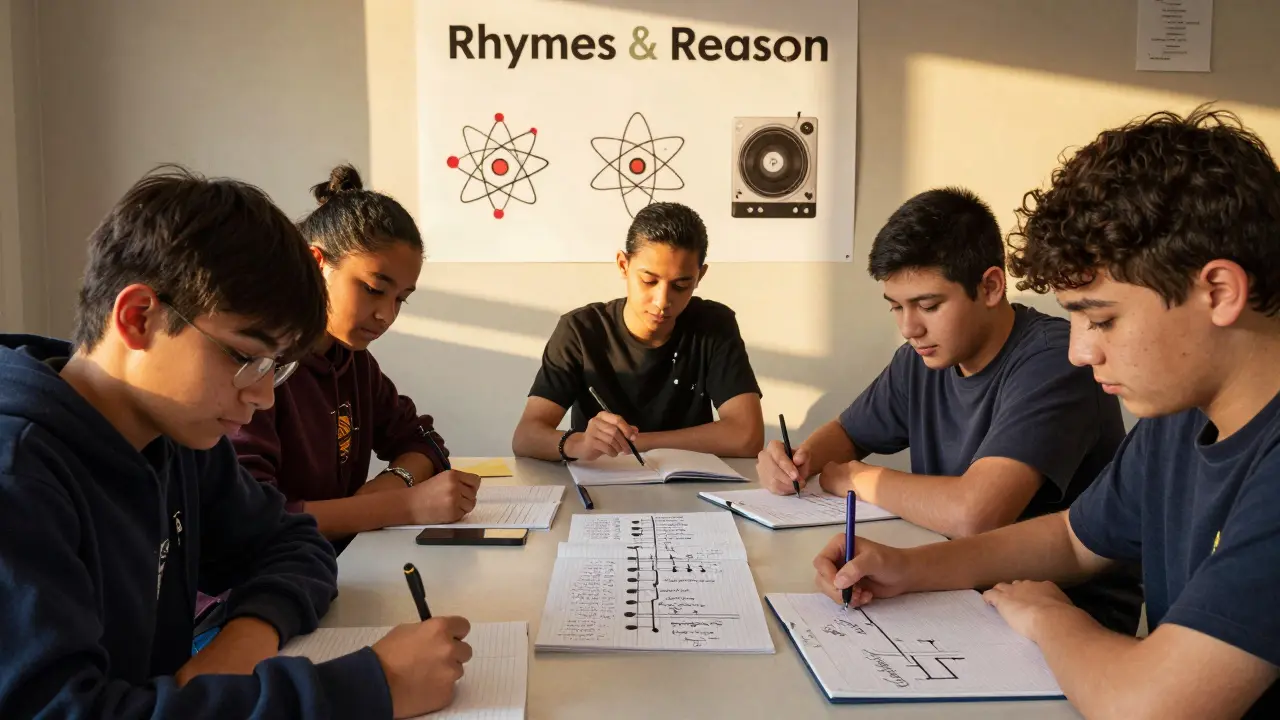
In Melbourne, a public school called Westridge Secondary started a program called "Rhymes & Reason" - where students write raps about scientific concepts. One group turned the periodic table into a rap battle. Another explained photosynthesis with a beat from Dr. Dre. Teachers reported that students who’d never raised their hands before were now volunteering to perform in front of the class. Engagement wasn’t just higher - it was sustained.
Even math is getting a remix. A Chicago teacher created "Math in the Mic," a curriculum where students solve quadratic equations by turning them into rhyme schemes. One student figured out how to factor polynomials by mapping them to syllable patterns in a rap verse. "I didn’t get it until I turned it into a flow," he said. "Now I see numbers like bars."
Connecting Culture and Curriculum
Hip hop didn’t come from textbooks. It was born in the Bronx in the 1970s - from block parties, turntables, and the need to be heard. That’s why it’s so effective in education: it’s rooted in identity, resistance, and expression. When students see their culture reflected in the classroom, they don’t just pay attention - they own the learning.
For Indigenous Australian students, blending traditional storytelling with hip hop beats has become a powerful way to teach language and history. In Darwin, Year 9 students collaborated with local elders to create rap tracks in Yolŋu Matha, blending ancient oral traditions with modern rhythm. The project didn’t just improve literacy - it strengthened cultural pride.
Same goes for immigrant communities. A Somali student in Sydney used hip hop to process her family’s journey from war to resettlement. Her poem-turned-rap about displacement became part of a school-wide spoken word festival. Her teacher said it was the first time she’d spoken in class for over a year.
What Teachers Are Actually Doing
You don’t need to be a rapper to use hip hop in teaching. Here’s what’s working in real classrooms:
- Lyric analysis as literary criticism - Students dissect metaphors, alliteration, and narrative structure in songs by Tupac, Lauryn Hill, or Cardi B.
- Beat-based memorization - Using rhythm to remember historical dates, multiplication tables, or vocabulary lists.
- Original rap creation - Students write and perform raps on science topics, historical events, or math problems.
- Comparative media studies - Analyzing how hip hop portrays mental health, gender, or politics versus traditional media.
- Debate through bars - Turning essay prompts into rap battles. Two students argue for/against climate policy - one raps each side.
These aren’t gimmicks. They’re pedagogical strategies backed by research from Harvard’s Graduate School of Education and the University of California, Los Angeles. Both institutions have published studies showing that hip hop-based instruction improves critical thinking, emotional regulation, and long-term retention.
Challenges and Misconceptions
Not every school is on board. Some parents and administrators still see hip hop as "too loud," "too rebellious," or "not academic enough." But that’s based on stereotypes - not what’s happening in classrooms.
The truth? Hip hop classrooms are structured. They’re rigorous. They demand precision. Writing a good rap requires understanding syntax, tone, pacing, and audience - all core literacy skills. And when students are proud of their work, they revise it. They edit. They practice. That’s the essence of learning.
Another myth? That it only works for struggling students. Actually, it works best for high achievers too. A 2025 survey of AP English teachers found that students who used hip hop to analyze Shakespeare’s sonnets scored higher on standardized exams than those who used only traditional methods.
Where to Start
If you’re a teacher wondering how to bring hip hop into your classroom, start small:
- Choose one song that connects to your current unit - something clean, lyrically rich, and culturally relevant.
- Play it once without explanation. Let students react.
- Ask: "What do you hear? What do you think they’re saying beneath the beat?"
- Build a lesson around their insights - don’t lead with the answer.
- Let students create their own version. No performance pressure. Just expression.
Resources like the Hip Hop Education Center and the National Association for Hip Hop Education offer free lesson plans, playlists, and training modules. You don’t need to be an expert. You just need to be open.
The Bigger Picture
Hip hop isn’t just changing how students learn - it’s changing who gets to be heard in school. For too long, education has valued one way of thinking: quiet, linear, written. Hip hop says: there’s power in rhythm. There’s intelligence in flow. There’s wisdom in voice.
When a kid who’s been labeled "disruptive" writes a 16-bar verse about climate change and the class erupts in applause, something shifts. Not just in their grades - in their sense of self.
This isn’t about replacing textbooks. It’s about expanding the tools we use to reach every learner. Because learning doesn’t happen in silence. Sometimes, it happens when the beat drops.
Can hip hop music really improve academic performance?
Yes. Multiple studies, including one from the University of Melbourne in 2023 and research from Harvard’s Graduate School of Education, show that students in hip hop-based programs improve in reading comprehension, critical thinking, and class participation. One study found a 37% increase in reading scores over a single semester. The key is using authentic lyrics as tools for analysis, not just entertainment.
Is hip hop appropriate for all age groups?
Absolutely - as long as the material is selected thoughtfully. Elementary teachers use clean, educational hip hop tracks to teach math facts or vocabulary. Middle and high school students engage with more complex themes like social justice, identity, and history. The content is matched to developmental stage, not eliminated because of genre.
Do I need to be a rapper to use hip hop in teaching?
No. Teachers don’t need to perform. They just need to be willing to listen. The power comes from letting students lead. Play a song, ask open questions, and build lessons around student responses. Many free lesson plans from organizations like the Hip Hop Education Center guide teachers step-by-step without requiring musical skills.
What if parents or administrators object to using hip hop?
Start with transparency. Share the goals: improved literacy, engagement, and critical thinking. Show examples of student work. Highlight the educational outcomes - not just the music. Many objections come from misunderstanding hip hop as purely entertainment. Once people see how it’s used to analyze poetry, history, or science, resistance often turns to support.
Are there any risks in using hip hop in schools?
The biggest risk is using lyrics without context. A song with violent or offensive language might trigger discomfort if not framed properly. Always preview material, select age-appropriate tracks, and pair them with guided discussion. The goal isn’t to glorify lyrics - it’s to critically engage with them. Done right, this builds media literacy, not rebellion.