
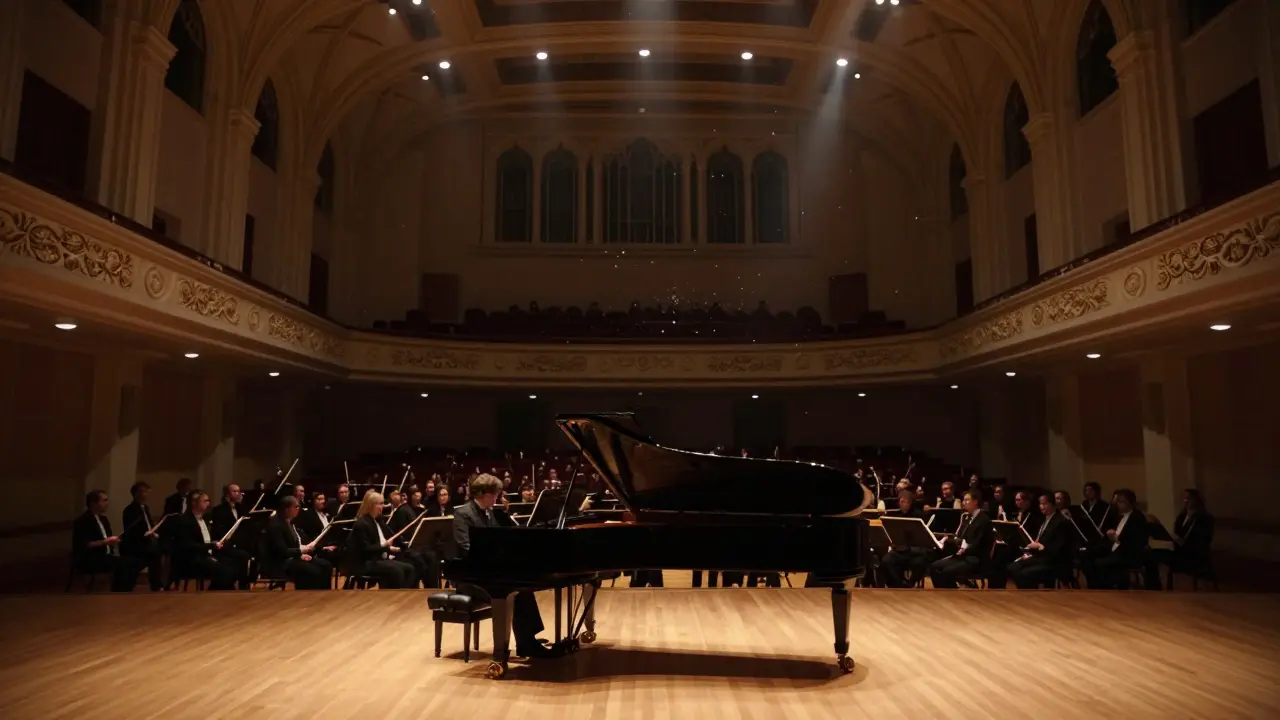
There is a specific kind of electricity that fills a concert hall when the soloist walks out for a piano concerto. It isn't just a song with an orchestra backing it up. It is a dramatic conversation, often a battle, between one person at a keyboard and eighty musicians in the pit. If you have ever wondered why some pieces feel like a lecture while others feel like a fistfight, you are looking at the difference between a symphony and a concerto.
A piano concerto is a musical composition for piano and orchestra, typically consisting of three movements that showcase the virtuosity of the soloist while integrating them with the full power of the ensemble. This form has evolved over three centuries, from the polite social gatherings of the Baroque era to the brutal, emotional landscapes of the 20th century. Understanding this genre changes how you listen. You stop hearing noise and start hearing strategy.
The Anatomy of a Piano Concerto
To appreciate these works, you need to know what you are listening for. Most piano concertos follow a standard three-movement structure established during the Classical period. Think of it as a narrative arc: tension, reflection, and resolution.
- First Movement (Fast): Usually in sonata-allegro form. This is where the main themes are introduced. The orchestra often starts with a "tutti" section, laying down the groundwork before the piano enters. The piano then takes those themes, twists them, and runs with them. It’s fast, complex, and technically demanding.
- Second Movement (Slow): A lyrical interlude. Here, the technical fireworks pause. The focus shifts to melody, harmony, and emotion. The orchestra often drops to a whisper, allowing the piano to sing. This is the heart of the piece.
- Third Movement (Fast Finale): Often a rondo or a set of variations. It is energetic, dance-like, and designed to leave the audience cheering. The boundary between the piano and orchestra blurs here; they play together in a unified rush toward the end.
This structure isn't rigid. Composers have broken it countless times, but knowing the baseline helps you spot when a composer is playing with your expectations.
From Bach to Beethoven: The Evolution
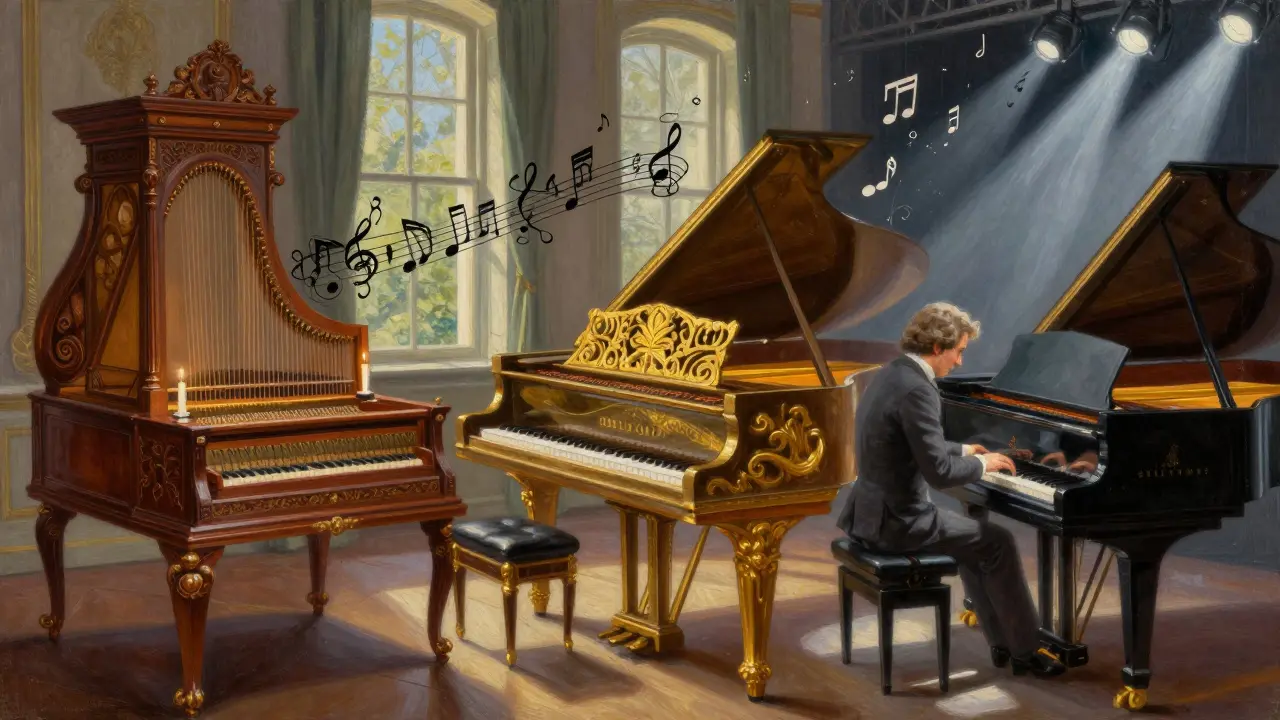
The history of the piano concerto is the history of the instrument itself. In the early days, there was no piano. There was the harpsichord.
Johann Sebastian Bach wrote his famous Brandenburg Concertos and Harpsichord Concertos in the Baroque era. These were not about individual ego. They were about texture and counterpoint-the weaving together of multiple independent melodic lines. The soloist was part of the fabric, not above it.
Then came the Classical era, and with it, the fortepiano (an early version of the modern piano). Wolfgang Amadeus Mozart revolutionized the form. He wrote twenty-three piano concertos that balanced elegance with deep emotional complexity. In Mozart's hands, the piano and orchestra became true partners. They answer each other. They argue. They reconcile. His Concerto No. 21 in C major remains one of the most recognizable pieces in Western music, largely due to its serene second movement.
But the real turning point arrived with Ludwig van Beethoven. Beethoven didn't just write music; he engineered sound. His five piano concertos, particularly the Emperor Concerto (No. 5), expanded the scale dramatically. The orchestra got louder, the harmonies got darker, and the technical demands on the pianist skyrocketed. Beethoven turned the concerto into a vehicle for personal expression rather than just public entertainment.
The Romantic Explosion
If Beethoven opened the door, the Romantic composers kicked it down. The 19th century was obsessed with the individual genius, and the piano concerto became the ultimate stage for showing off.
Frédéric Chopin wrote only two piano concertos, but they changed everything. For Chopin, the orchestra was often just colored background noise. The piano was the star, singing with a vocal quality that had never been heard before. His Concerto No. 1 in E minor feels less like a public performance and more like a private confession.
Meanwhile, Pyotr Ilyich Tchaikovsky brought Russian soul and massive orchestral forces to the table. His Romanze from the First Piano Concerto is so beautiful it hurts. But it is the opening chords-those massive, bell-like strikes-that define the piece. Tchaikovsky proved that a concerto could be both technically terrifying and emotionally overwhelming.
We cannot talk about this era without mentioning Sergei Rachmaninoff. Rachmaninoff had enormous hands and wrote music that required them. His Piano Concerto No. 2 is arguably the most popular concerto in the world today. It is lush, melancholic, and incredibly difficult. It represents the peak of late-Romantic excess, where every note is drenched in harmony.
Modern Challenges and New Voices
In the 20th and 21st centuries, the rules broke down. Composers stopped trying to please the audience with pretty melodies and started exploring rhythm, dissonance, and new sounds.
Béla Bartók infused his concertos with folk rhythms and percussive piano techniques. His music doesn't just flow; it attacks. Sergei Prokofiev, known for Romeo and Juliet, wrote piano concertos that are witty, satirical, and mechanically precise. His Fifth Piano Concerto is often described as being harder than any piece by Rachmaninoff.
Today, contemporary composers continue to push boundaries. Works by John Adams or Philip Glass use minimalism to create hypnotic, repetitive structures that differ vastly from the thematic development of Beethoven. Even pop culture intersects with this form; Andrew Lloyd Webber's Warriors suite or film scores by Hans Zimmer often borrow the concerto format to highlight a solo instrument against a large ensemble.
Comparing the Giants
| Composer | Key Work | Era | Distinguishing Feature |
|---|---|---|---|
| Mozart | No. 21 in C Major | Classical | Balanced dialogue between piano and orchestra |
| Beethoven | No. 5 "Emperor" | Classical/Romantic | Heroic scale and dramatic intensity |
| Chopin | No. 1 in E Minor | Romantic | Vocal, lyrical piano lines; subtle orchestration |
| Tchaikovsky | No. 1 in B-flat Minor | Romantic | Massive opening chords; rich Russian melody |
| Rachmaninoff | No. 2 in C Minor | Late Romantic | Lush harmony; extreme technical difficulty |
| Prokofiev | No. 5 in G Major | 20th Century | Neoclassical precision; mechanical energy |
Why the Piano Concerto Endures
You might ask why we still care about a form that dates back to the 1700s. The answer lies in human psychology. We love stories of conflict and resolution. We are drawn to displays of mastery. And we crave beauty.
A piano concerto delivers all three. It pits the individual against the collective. It shows us what the human body can achieve through years of discipline. And it provides moments of sheer acoustic splendor that few other art forms can match. Whether you are listening to the delicate wit of Mozart or the crushing weight of Rachmaninoff, you are experiencing a unique intersection of technology (the instrument) and artistry (the composer).
Next time you hear a piano concerto, don't just listen to the notes. Listen to the relationship. Who is leading? Who is following? When do they fight, and when do they embrace? That is where the magic lives.
What is the difference between a piano concerto and a piano sonata?
A piano sonata is written for piano alone, focusing entirely on the capabilities of the solo instrument. A piano concerto features a solo piano accompanied by an orchestra. The concerto emphasizes the interaction, contrast, and dialogue between the soloist and the larger ensemble, whereas the sonata explores the internal resources of the piano itself.
Which piano concerto is considered the hardest to play?
Difficulty is subjective, but Sergei Rachmaninoff's Third Piano Concerto and Prokofiev's Fifth Piano Concerto are widely regarded as among the most technically demanding. They require immense physical strength, rapid fingerwork, and complex coordination. Busoni's Concerto in C is also notorious for its sheer length and technical obstacles.
Who invented the piano concerto?
The form evolved from the Baroque "concerto grosso," which featured a small group of soloists against an orchestra. Johann Sebastian Bach adapted this for the harpsichord. However, Wolfgang Amadeus Mozart is credited with establishing the modern piano concerto form, balancing the soloist and orchestra in a way that defined the Classical era.
Why do piano concertos usually have three movements?
The three-movement structure (fast-slow-fast) became the standard during the Classical period because it provided a balanced emotional journey. The first movement establishes conflict and theme, the second offers lyrical reflection, and the third provides a celebratory or energetic resolution. This arc mirrors traditional storytelling structures.
Can a beginner learn a piano concerto?
Generally, no. Piano concertos are professional-level works requiring advanced technique. However, simplified arrangements exist for educational purposes. Additionally, some shorter or simpler concertos, like those by Mozart or early works by Haydn, may be approachable for very advanced students under the guidance of a teacher, but full orchestral versions are reserved for conservatory-level pianists.
What is a cadenza in a piano concerto?
A cadenza is a passage near the end of the first movement where the orchestra stops playing, and the soloist performs an extended, unaccompanied solo. Historically, pianists would improvise this section to show off their skill. Today, composers usually write the cadenza out, though performers still add personal touches to tempo and phrasing.