
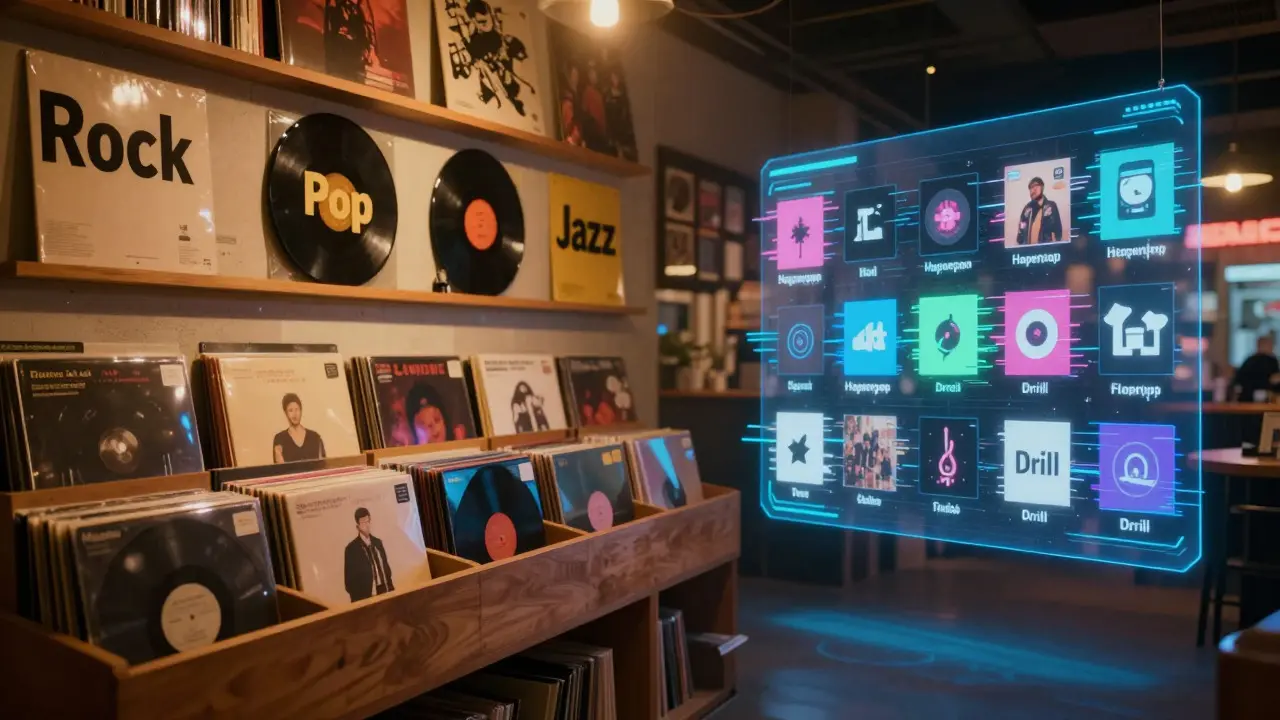
Remember when you could walk into a record store and find everything under three or four main signs? Rock, Pop, Jazz, Country. It was simple. Today, if you ask a teenager what they listen to, you might hear terms like "hyperpop," "drill," "lo-fi hip hop," or "witch house." The landscape has fractured. This isn't just about labels changing; it’s a fundamental shift in how we create, consume, and categorize sound. We are living through an explosion of music subgenres, and this revolution is reshaping the entire industry.
This fragmentation wasn't accidental. It happened because technology removed the gatekeepers. In the past, radio stations and major record labels decided what got airplay. They needed broad categories to sell ads to mass audiences. If your music didn't fit neatly into "Rock" or "Pop," it stayed underground. Today, streaming platforms and social media algorithms don't care about broad boxes. They care about specific vibes, moods, and sonic textures. This allows incredibly niche sounds to find their exact audience, no matter how small that audience might be globally.
The Death of the Gatekeeper and the Rise of Micro-Genres
To understand why subgenres have exploded, we have to look at the tools available to artists today. Twenty years ago, recording high-quality music required expensive studio time and professional engineers. Now, a bedroom producer with a laptop and free software can create complex tracks. This democratization led to a surge in experimentation. When barriers to entry drop, variety increases.
Consider the evolution of electronic dance music (EDM). In the early 2010s, EDM was largely dominated by festival-friendly big room house. But as producers gained access to more sophisticated synthesizers and drum machines, they began tweaking parameters slightly. A faster tempo here, a distorted bassline there. These small changes accumulated over time, creating distinct micro-genres like "trap," "future bass," and "dubstep." Each of these started as a tiny deviation from the norm but eventually became massive movements with their own festivals, influencers, and fanbases.
This process happens across all genres. Hip-hop, once broadly categorized, now includes subgenres like "cloud rap," "plugg," and "rage." Each has specific production techniques, vocal styles, and cultural associations. Artists aren't trying to appeal to everyone anymore; they're trying to speak directly to a specific community. This hyper-targeting creates stronger loyalty among fans because the music feels personally curated for them.
| Aspect | Traditional Model (Pre-2010) | Modern Model (Post-2020) |
|---|---|---|
| Primary Driver | Radio formats & Record Labels | Algorithms & Social Media Trends |
| Categorization | Broad (Rock, Pop, Jazz) | Granular (Lo-fi, Drill, Hyperpop) |
| Discovery Method | Human Curators (DJs, Critics) | Data-Driven Recommendations |
| Artist Goal | Mainstream Appeal | Niche Community Engagement |
| Lifespan of Trend | Years to Decades | Months to Years |
How Algorithms Fuel Fragmentation
Streaming services like Spotify and Apple Music play a huge role in this revolution. Their recommendation engines rely on collaborative filtering and audio analysis. They don't just look at what genre an artist claims; they analyze the actual sound-tempo, key, instrumentation, and even mood. If a song shares sonic similarities with other popular tracks, it gets recommended to listeners who enjoy those tracks.
This creates feedback loops. A listener enjoys a specific type of indie folk, so the algorithm serves them more songs with similar acoustic guitar patterns and melancholic vocals. Over time, this isolates listeners in "filter bubbles" where they only hear variations of one very specific sound. While this helps users discover new music they love, it also accelerates the splitting of genres. What might have been considered "Indie Folk" ten years ago is now split into "chamber pop," "folktronica," and "bedroom pop" based on subtle production differences.
Social media platforms, particularly TikTok, accelerate this further. On TikTok, music is often used as background for short videos. A specific instrumental hook or beat might go viral because it fits a certain aesthetic or challenge. Producers then rush to create more songs using that same sound, solidifying it as a recognizable subgenre. For example, the rise of "Phonk"-a genre characterized by cowbells, heavy distortion, and Memphis rap samples-was heavily driven by TikTok car culture videos. Without the platform's ability to rapidly spread specific audio clips, Phonk might have remained obscure.
Case Study: The Explosion of Latin Urban Music
A clear example of subgenre revolution is the global takeover of Latin urban music. In the early 2010s, Reggaeton was the dominant force. But as artists experimented, new subgenres emerged. "Trap Latino" incorporated heavier 808 basslines and darker lyrics inspired by American trap music. Later, "Dembow" from the Dominican Republic gained international traction, offering a faster, more rhythmic alternative.
Artists like Bad Bunny and Karol G didn't stick to one lane. They blended Reggaeton, Trap, Dembow, and even traditional Salsa elements. This fluidity confused traditional radio programmers but delighted streaming audiences. Fans didn't want to be told what category the music fell into; they just wanted to hear the vibe. As a result, Latin music stopped being a "niche" market for English-speaking audiences and became a mainstream global powerhouse. The subgenres allowed for artistic growth while maintaining cultural authenticity.
The Challenge for Artists and Labels
While this revolution offers opportunities, it brings challenges. For artists, staying relevant requires constant innovation. Because subgenres emerge and fade quickly, an artist who defines themselves by one micro-genre risks becoming obsolete when the trend shifts. This pressure can lead to creative burnout or a lack of artistic identity.
For record labels, marketing becomes more complex. Traditional advertising relies on broad demographics. How do you advertise a song that appeals only to fans of "vaporwave" or "synthwave"? Labels are increasingly turning to data analytics to identify emerging subgenres before they peak. They scout artists not just for talent, but for their ability to ride the wave of a growing micro-trend.
Additionally, the sheer volume of content makes discovery difficult. With millions of songs uploaded daily, even great music can get lost in the noise. Artists must become marketers, engaging directly with communities on social media to build a following. The label's role has shifted from gatekeeper to amplifier.
Is There a Future for Broad Genres?
Despite the fragmentation, broad genres haven't disappeared. They still serve as useful shorthand for casual listeners. However, their meaning has changed. "Rock" today encompasses everything from classic hard rock to shoegaze and post-punk revival. The umbrella term remains, but the branches beneath it are denser and more diverse than ever.
We are likely seeing a move toward hybridization. As subgenres proliferate, artists begin mixing them. You see this in the rise of "country-rap" or "K-pop-R&B." These hybrids create new spaces that defy traditional categorization. The future of music may not be about choosing one subgenre, but about blending multiple influences to create something entirely new.
This evolution reflects our broader cultural shift toward personalization. We expect our news, our shopping recommendations, and our entertainment to be tailored to us. Music is no exception. The revolution of subgenres is simply the music industry adapting to a world where individual taste matters more than collective consensus.
What This Means for Listeners
For the average listener, this means endless choice but also potential overwhelm. You have to be more active in curating your own experience. Relying solely on "Top 50" charts might limit you to the most commercially viable sounds. Exploring playlists curated by independent creators or diving into algorithmic deep cuts can reveal hidden gems.
It also means connecting with communities. Finding others who share your interest in a specific subgenre can enhance the listening experience. Online forums, Discord servers, and social media groups dedicated to niche genres provide spaces for discussion, recommendation, and connection. Music is still social, even if the tribes are smaller and more specialized.
The revolution of subgenres is not a passing fad. It is the new normal. As technology continues to lower barriers to creation and distribution, we can expect even more fragmentation. But within that chaos lies incredible creativity. By embracing the diversity of subgenres, we gain access to a richer, more nuanced musical landscape than ever before.
Why are there so many music subgenres now compared to the past?
The increase in subgenres is driven by digital technology and streaming algorithms. In the past, radio and record labels acted as gatekeepers, promoting only broad categories to maximize audience reach. Today, anyone can produce and distribute music online. Streaming platforms use algorithms to match specific sonic traits with listener preferences, allowing niche sounds to find dedicated audiences without needing mainstream approval.
Do music subgenres help or hurt artists?
Subgenres offer both benefits and challenges. They allow artists to find a loyal niche audience and express unique creative visions without conforming to mainstream standards. However, micro-genres can have short lifespans, forcing artists to constantly evolve to stay relevant. Additionally, the oversaturation of content makes it harder for new artists to stand out without strong marketing skills.
How do streaming algorithms influence the creation of new subgenres?
Streaming algorithms analyze audio features like tempo, key, and instrumentation to recommend songs. When a specific sound gains traction, the algorithm promotes similar tracks, creating a feedback loop. This encourages producers to replicate successful sonic elements, leading to the rapid formation and consolidation of new subgenres. Social media platforms like TikTok further accelerate this by making specific audio clips viral.
Can traditional broad genres like Rock or Pop survive this fragmentation?
Yes, but their role has changed. Broad genres now act as umbrellas for numerous subgenres rather than strict categories. For example, "Pop" today includes hyperpop, synth-pop, and bedroom pop. These overarching terms remain useful for casual conversation and general classification, but serious music discussion often requires referencing specific subgenres to accurately describe the sound.
What is the impact of subgenres on music consumption habits?
Subgenres encourage more active listening and curation. Instead of passively consuming top-charted hits, listeners often dive deep into specific playlists or communities aligned with their tastes. This leads to greater engagement with music culture, including participation in online forums and social media discussions. It also fosters a sense of belonging within niche communities.