
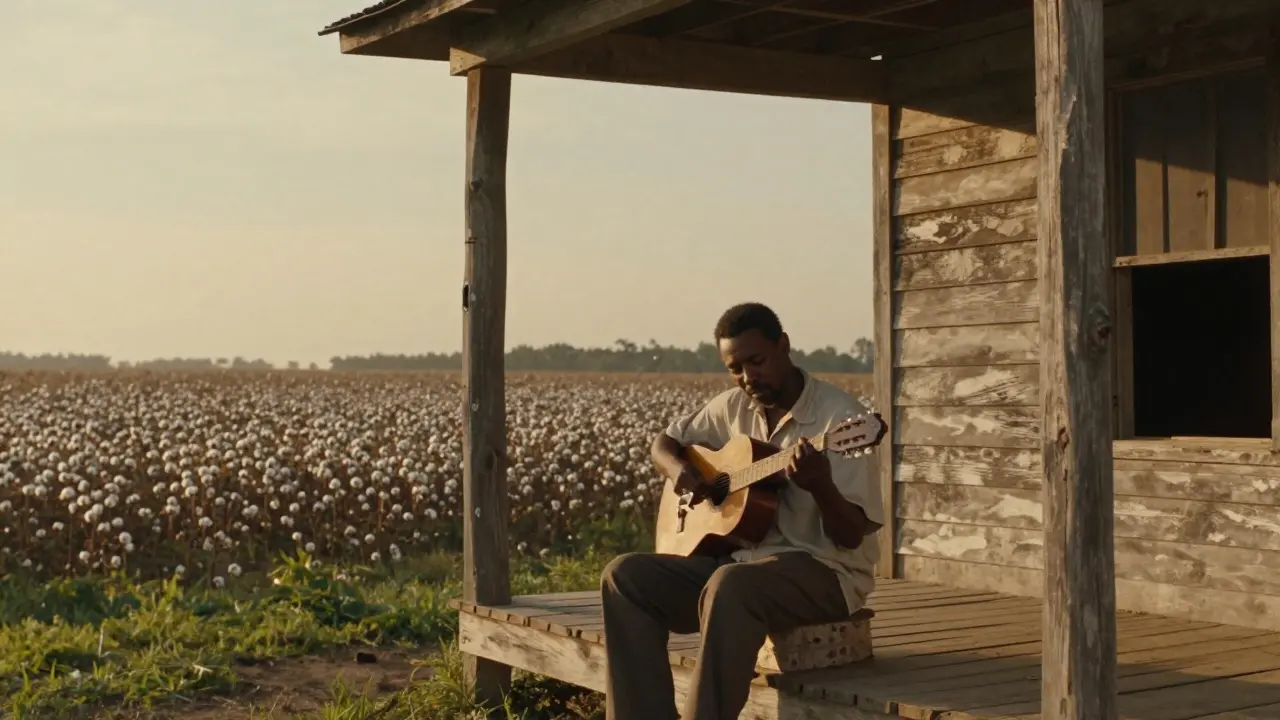
The Roots in the Deep South
To understand the blues, you have to go back to the Mississippi Delta. It didn't start in a studio; it started in the fields. The music grew out of African American spirituals, work songs, and shouts. Imagine people working under a brutal sun, using call-and-response patterns to keep their pace and their sanity. These weren't rehearsed compositions but spontaneous expressions of a hard life. By the early 1900s, this evolved into Delta Blues, which is the earliest popularized style of blues, characterized by sparse instrumentation and a strong connection to the singer's emotional state. You'd often find a lone musician with an acoustic guitar, using a slide-sometimes just a glass bottleneck or a piece of metal-to mimic the human voice. This "crying" sound of the guitar is what gives the genre its haunting quality. It was a raw, intimate experience that focused on the struggle of the individual against a crushing system.The Magic of the Blue Note
What makes the blues sound like the blues? It's all in the notes. Most Western music sticks to a standard scale, but the blues introduces "blue notes." These are notes that are played or sung at a slightly lower pitch than the standard major scale, creating a tension that feels unresolved. This tension is a sonic metaphor for life's frustrations. When a singer hits a blue note, they aren't hitting a "wrong" note; they are capturing a feeling that doesn't fit into a neat box. Pair this with the 12-bar blues structure-a repetitive chord progression that creates a predictable loop-and you have a framework where the performer can improvise. This structure allows the artist to wander, scream, or whisper, knowing the music will eventually bring them back home to the root chord. It's the perfect balance of discipline and total freedom.| Style | Primary Instrument | Key Characteristics | Typical Setting |
|---|---|---|---|
| Delta Blues | Acoustic Guitar / Harmonica | Raw, slide guitar, solo performance | Juke Joints / Fields |
| Chicago Blues | Electric Guitar / Harmonica | Amplified sound, full band, driving beat | City Clubs / Urban Centers |
| Texas Blues | Electric Guitar | Swing influence, cleaner tones, rhythmic | Dance Halls |
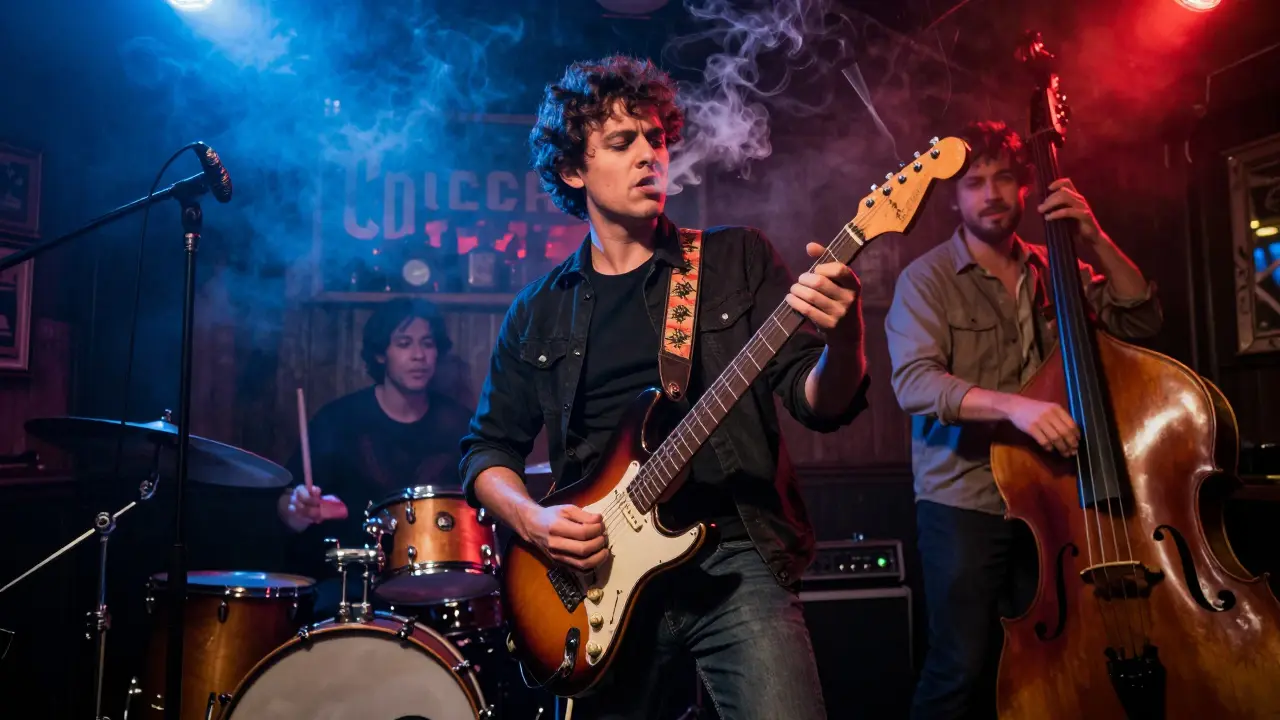
The Great Migration and the Electric Shift
As thousands of people moved from the rural South to cities like Chicago and Detroit in the mid-20th century, the music changed. You can't play a quiet acoustic guitar in a noisy city club filled with people wanting to dance. This necessity gave birth to Chicago Blues, which is an electrified version of the Delta Blues that incorporated drums and bass to cut through the noise of urban environments. This is where the Electric Guitar became the undisputed king. Musicians like Muddy Waters plugged in their instruments, creating a distorted, powerful sound that mirrored the intensity of city life. The music became louder, faster, and more aggressive. It wasn't just about mourning anymore; it was about asserting presence. The addition of a drum kit turned the blues from a solitary lament into a communal celebration, paving the way for the dance floors of the 1950s.Architects of the Sound
No discussion of the blues is complete without mentioning the giants who shaped the language of the genre. Robert Johnson is perhaps the most mythologized. The legend says he sold his soul to the devil at a crossroads in Mississippi to master the guitar. While that's likely a tall tale, his influence was real. His complex fingerpicking style made it sound like two people were playing one guitar, which terrified and amazed his contemporaries. Then you have B.B. King, who moved the blues into the mainstream. Unlike the raw grit of the Delta, King brought a sophisticated, melodic approach. He didn't play a thousand notes; he played the *right* note and let it vibrate. His guitar, famously named "Lucille," became an extension of his voice. He proved that the blues could be polished and professional without losing its emotional core. By blending the blues with jazz and gospel, he opened the door for the genre to reach global audiences.
How Blues Birthed Rock and Roll
If you love rock music, you are essentially listening to the evolved child of the blues. In the 1950s and 60s, artists like Chuck Berry took the 12-bar blues structure and sped it up, adding a heavy backbeat. This transformed the "sad" songs into high-energy anthems. Across the Atlantic, British musicians in the 60s became obsessed with old American blues records. Bands like The Rolling Stones and Led Zeppelin spent their early years mimicking the phrasing and grit of Muddy Waters and Howlin' Wolf. They didn't just copy the notes; they adopted the attitude of rebellion and authenticity. This cross-pollination created a feedback loop where the blues traveled from the US to the UK and then back to America as the foundation of the rock revolution. Without the blue note and the distorted electric riff, the stadium concerts of the 70s simply wouldn't exist.The Modern State of the Blues
Is the blues still relevant in an era of synthesizers and AI? Absolutely. While it may not dominate the Billboard charts, the spirit of the blues is everywhere. You hear it in the soulful runs of modern R&B, the gritty vocals of indie rock, and the improvisational nature of modern jazz. Today, the genre lives on through festivals and dedicated clubs where the focus remains on the human element. The modern blues scene is less about a specific region and more about a shared emotional language. Whether it's a performer in Melbourne or a singer in Memphis, the goal is the same: to take a personal struggle and turn it into a universal truth. The blues teaches us that by sharing our pain, we actually find a way to heal it.What is the difference between the blues and jazz?
While both share African American roots and use blue notes, jazz is generally more complex in its harmony and structure. Jazz focuses heavily on sophisticated improvisation and intricate chord changes, whereas the blues relies on a simpler, more repetitive structure (like the 12-bar blues) to emphasize emotional storytelling and raw expression.
Why is the guitar so central to blues music?
The guitar's ability to bend strings allows the musician to mimic the human voice, especially the "crying" or "moaning" sounds associated with emotional distress. Its portability also made it ideal for early itinerant musicians traveling through the Delta.
What is a 12-bar blues?
It is a standard musical structure consisting of 12 bars (measures) of music. It typically follows a progression involving the I, IV, and V chords. This repetitive cycle creates a predictable foundation that allows the singer or instrumentalist to improvise freely without losing the rhythm.
Who are some essential blues artists to start with?
For the raw, early sound, listen to Robert Johnson and Son House. For the transition to electric urban sound, Muddy Waters and Howlin' Wolf are essential. For a more melodic and polished experience, B.B. King and Albert King are the gold standards.
Can you play the blues if you aren't a professional musician?
Yes! One of the most beautiful things about the blues is that it values emotion over technical perfection. Because the structure is repetitive and predictable, it is one of the most accessible genres for beginners to learn and improvise within.