
The Energy Chain: From Finger to Air
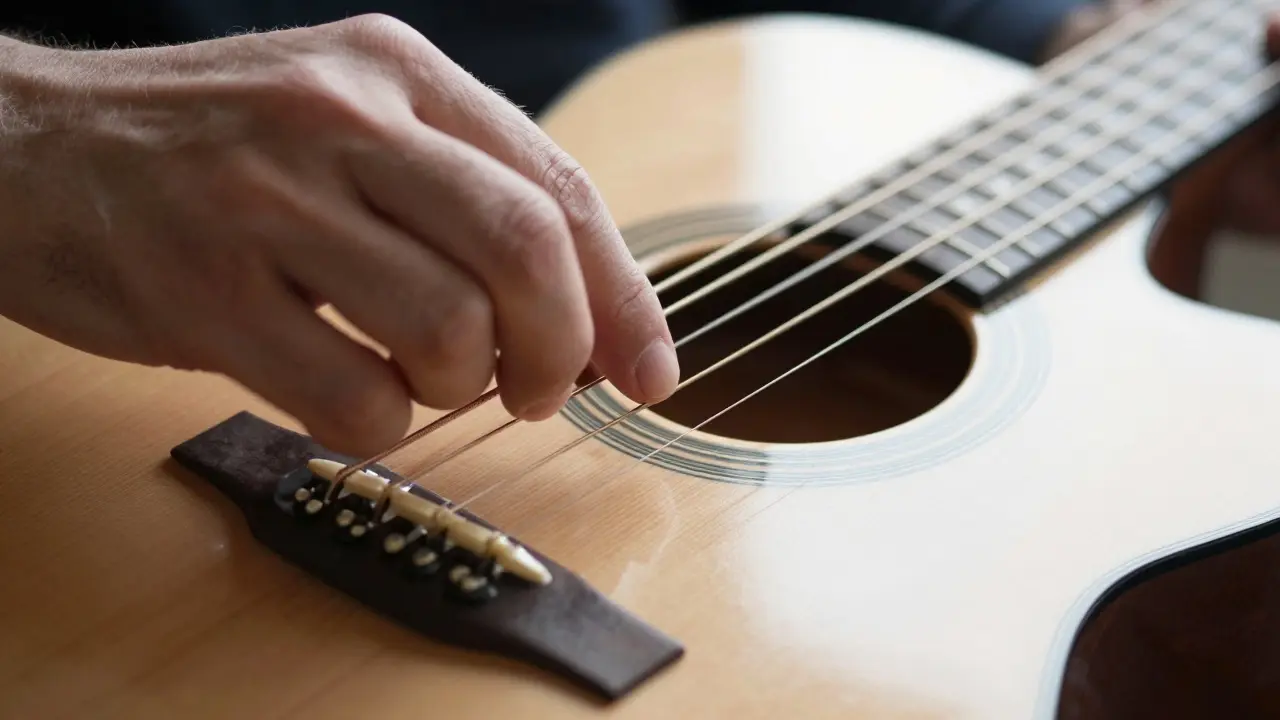
To understand acoustic guitar physics, we have to follow the energy. It starts with your finger displacing a string, creating potential energy. The moment you let go, that energy converts into kinetic energy, causing the string to oscillate. But if you stretched a string between two concrete pillars, you'd barely hear it. Why? Because the string has a very small surface area and can't push much air.This is where the Bridge is the mechanical link that transfers string vibrations into the guitar's body comes in. The bridge acts as a transducer, driving the energy down into the top of the guitar. From there, the vibration spreads across the soundboard, which acts like a giant speaker cone, pushing a massive volume of air out of the soundhole and through the body.
The Soundboard: The Heart of the Instrument
The top piece of wood, often called the soundboard, is the most critical part of the guitar. If the top is too thick, it won't vibrate enough, and the guitar will sound "stiff" or quiet. If it's too thin, it might collapse under the tension of the strings or sound muddy.Most high-end guitars use Sitka Spruce, which is a softwood prized for its high strength-to-weight ratio, allowing it to be carved thin while remaining durable . Because it is stiff yet light, it responds quickly to the string's energy, creating a crisp, clear attack. When you play a chord, the soundboard doesn't just move up and down; it flexes in complex patterns, creating a rich spectrum of frequencies.
Bracing: The Invisible Architect
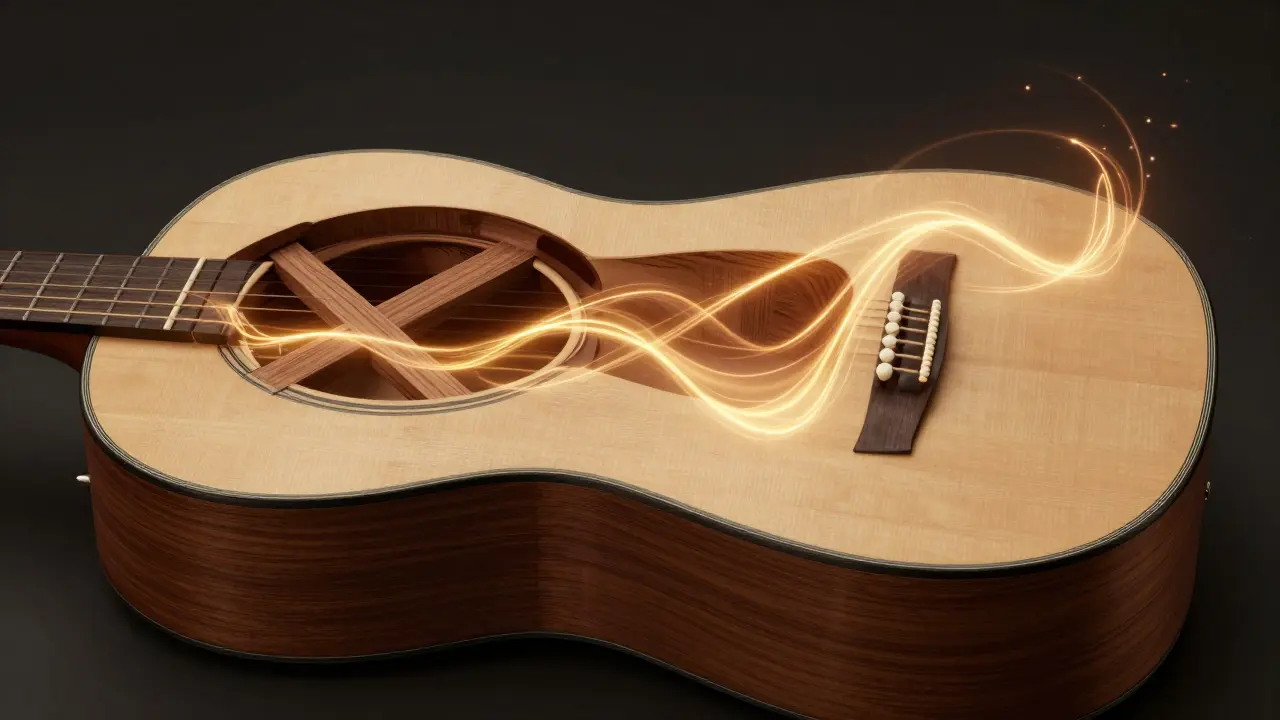
If you could peek inside a guitar, you'd see strips of wood glued to the underside of the top. This is the bracing. Without it, the bridge would simply rip the top off the guitar due to the roughly 160 pounds of tension from the strings.The most famous design is X-Bracing, a structural pattern where two main braces cross in an 'X' shape to provide stability and enhance bass response . By carving these braces (a process called "voicing"), luthiers can control which frequencies are emphasized. If a builder shaves a bit more wood off the lower bout braces, the guitar will likely produce more booming low-end. It's a delicate balance between structural integrity and acoustic flexibility.
| Wood Type | Role | Primary Attribute | Sound Characteristic |
|---|---|---|---|
| Sitka Spruce | Top/Soundboard | Stiffness | Clear, Loud, Balanced |
| Indian Rosewood | Back and Sides | Density | Deep Lows, Sparkling Highs |
| African Mahogany | Back and Sides | Porosity | Warm, Mid-range Focused |
| Maple | Neck/Back | Hardness | Bright, Transparent, Fast Decay |
The Role of Body Shape and Volume
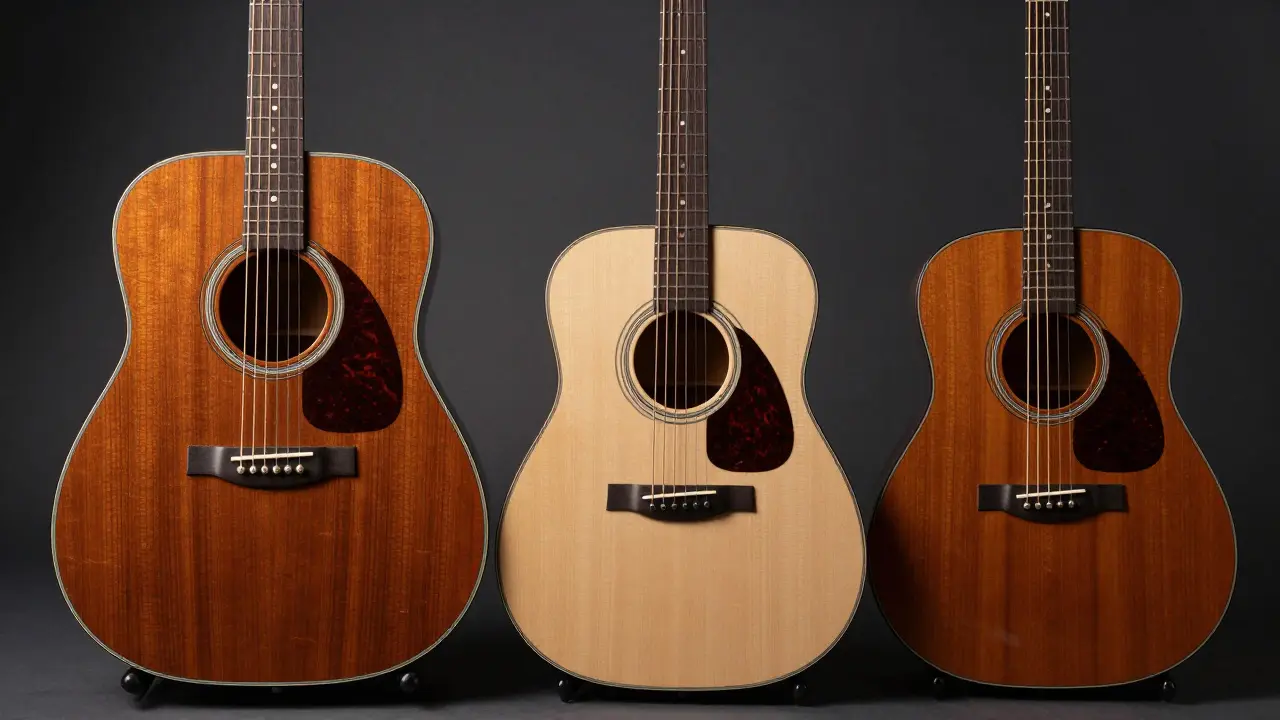
Why does a Dreadnought sound different from a Concert guitar? It comes down to the volume of the air inside the box. The body of the guitar acts as a Helmholtz Resonator, which is a phenomenon where the air inside a cavity vibrates at a specific frequency based on the volume of the cavity and the size of the opening .A larger body, like a Dreadnought, has more internal air, which naturally resonates at a lower frequency. This is why they are the go-to for bluegrass and folk-they provide that deep, thumping bass that can compete with a banjo. Smaller bodies, like Parlor guitars, have a higher resonant frequency, making them sound "mid-heavy" and punchy. This makes them ideal for recording, as they don't "bleed" into other microphones with excessive low-end rumble.
Harmonics and the Overtone Series
When you hit a single note, you aren't actually hearing one frequency. You're hearing a fundamental note plus a series of Overtones, higher frequencies that are multiples of the fundamental frequency, giving an instrument its unique timbre .The materials and construction of the guitar determine which overtones are amplified and which are suppressed. A guitar made of dense Rosewood reflects more energy back into the body, creating a "shimmering" effect with many complex overtones. Mahogany, being more porous, absorbs some of those high-frequency overtones, resulting in a "drier" or more "woody" sound. This is why a session musician might choose a mahogany guitar for a dense mix-it stays out of the way of the vocals.
The Science of the Nut and Saddle
We often overlook the tiny pieces of bone or plastic at the ends of the strings, but they are the primary points of contact. The Saddle, located on the bridge, determines how the vibration is transmitted to the soundboard.A hard material like bone transmits energy more efficiently than a soft plastic saddle. If the saddle is too high, it increases the break angle of the string, putting more downward pressure on the soundboard, which can actually increase the volume. However, if the pressure is too high, it can "choke" the top, reducing the dynamic range. It's all about the physics of pressure and transmission.
Does the type of string actually change the science of the sound?
Absolutely. Phosphor Bronze strings have a higher mass and different elasticity than 80/20 Bronze. Higher mass generally leads to a warmer, deeper tone because they vibrate at a slightly lower frequency and exert more force on the soundboard, pushing more air.
Why do older guitars sound "better"?
This is due to a process called cellular degradation and resin crystallization. Over decades, the resins in the wood harden and the cellular structure becomes more stable and lightweight. This allows the top to vibrate more freely and consistently, which players describe as an "opened up" sound.
How does humidity affect the acoustics?
Wood is hygroscopic, meaning it absorbs water from the air. When wood swells with moisture, it becomes heavier and less stiff, which dampens the vibrations and makes the guitar sound muddy. Conversely, too little humidity causes the wood to shrink and become brittle, which can lead to cracks and a harsh, thin tone.
Do guitar coatings (lacquer vs. polyurethane) matter?
Yes. Polyurethane is essentially a plastic shell that can dampen the vibrations of the soundboard. Nitrocellulose lacquer is much thinner and more flexible, allowing the wood to breathe and vibrate more naturally, which is why vintage-style finishes are preferred by purists.
Can you actually "hear" the difference between different types of spruce?
Yes, though it's subtle. Adirondack spruce is stiffer than Sitka spruce, meaning it has a higher "ceiling"-you can play it harder before the sound breaks up. Sitka is more responsive to a lighter touch, making it better for fingerstyle players.