
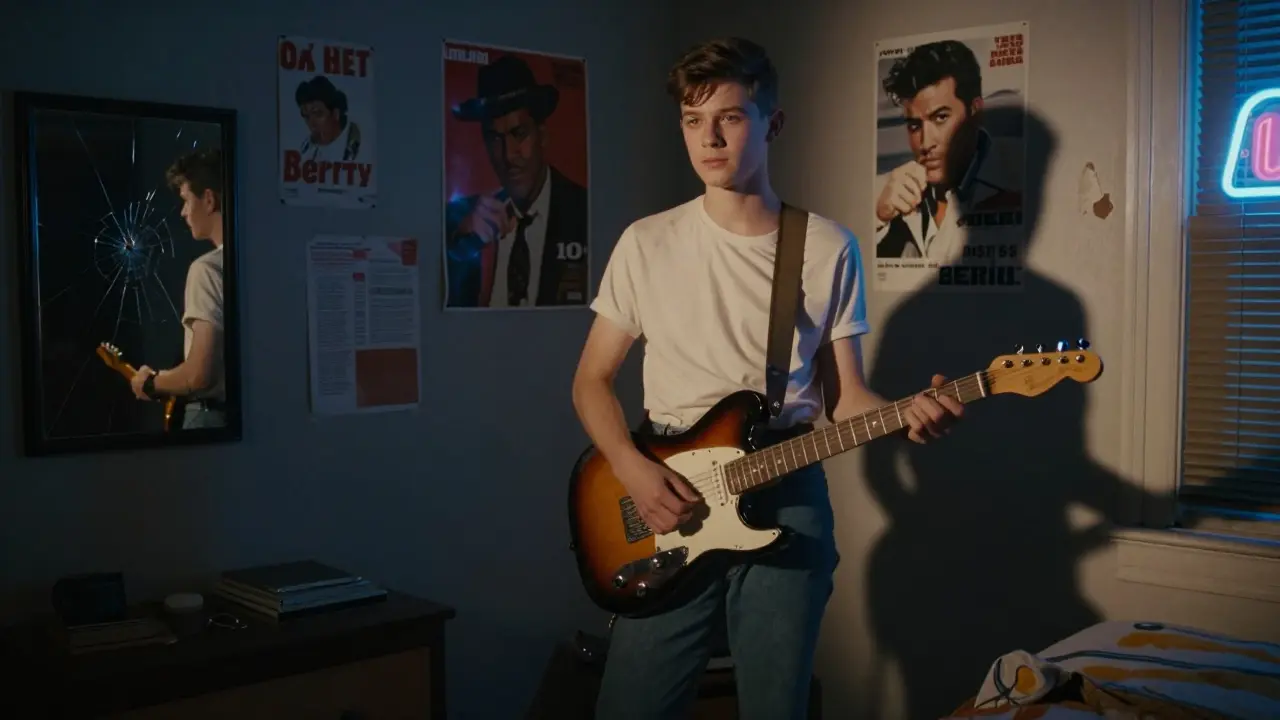
Electric guitar didn’t just change how music sounded-it rewired how people lived, dressed, talked, and rebelled. Before it, music was something you listened to quietly, often in a parlor or at a dance hall. After it, the electric guitar became a symbol of freedom, danger, and identity. It turned teenagers into icons, turned amplifiers into weapons of expression, and turned silent rooms into roaring arenas. This isn’t just about strings and pickups. It’s about how a piece of wood, wire, and magnetism became the voice of a generation.
From Silent Strings to Screaming Amps
The first electric guitars appeared in the 1930s, built by companies like Rickenbacker and Gibson to help guitarists be heard over brass bands and big orchestras. Early models like the Rickenbacker ‘Frying Pan’ looked strange-metal bodies, no hollow chambers, no warmth. But they worked. Jazz musicians picked them up first, then blues players in Chicago and Mississippi started twisting the knobs, pushing the amps into distortion. That crackle, that growl, wasn’t a flaw-it was a new language.
By the 1950s, Leo Fender’s Stratocaster and Telecaster gave players more control, more comfort, more possibilities. The Strat’s three pickups let you switch between bright, twangy tones and thick, singing leads. The Tele’s simple design made it rugged, reliable, and perfect for country, rockabilly, and eventually punk. These weren’t just instruments-they were tools for sonic rebellion.
Rock ‘n’ Roll Wasn’t Born-It Was Amplified
Chuck Berry didn’t just play guitar-he performed with it. He duck-walked, kicked his legs, and let the strings scream while the crowd screamed louder. His riffs on ‘Johnny B. Goode’ became the blueprint for every rock guitarist who came after. He made the electric guitar the center of attention, not just background rhythm. Suddenly, the guitarist wasn’t the quiet guy in the corner. He was the star.
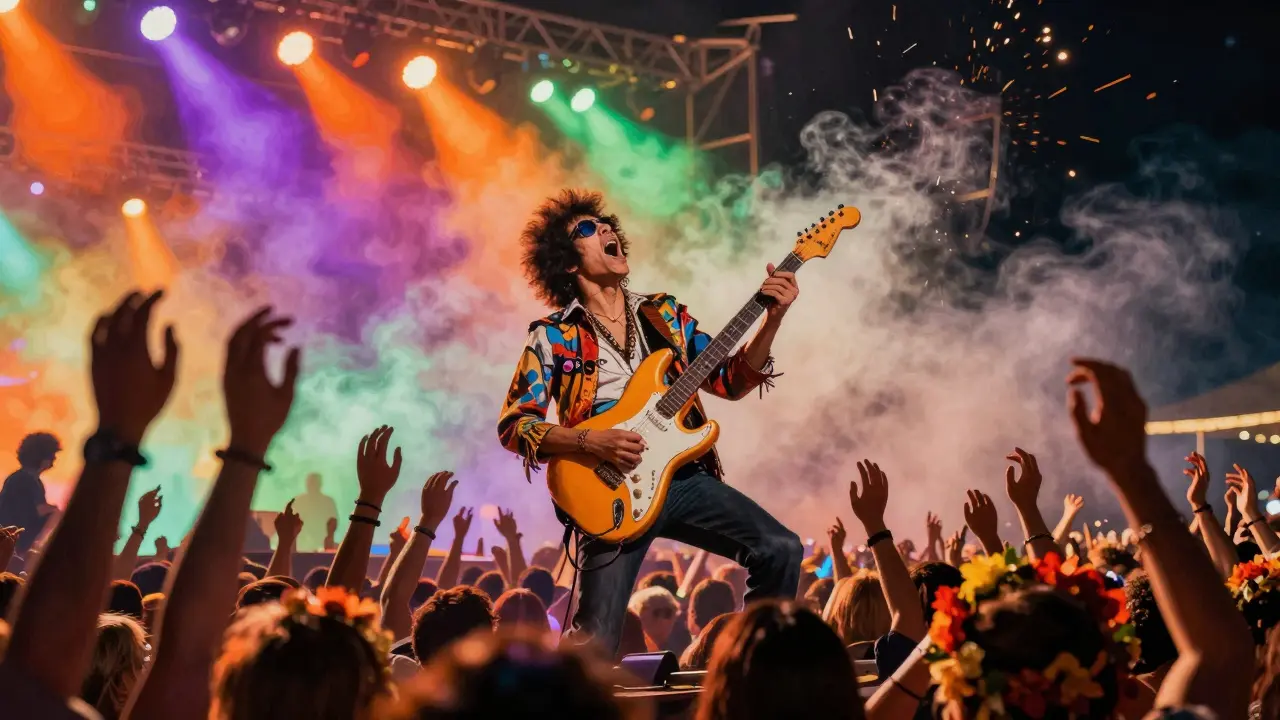
Then came Jimi Hendrix. He didn’t just play chords-he made the guitar cry, laugh, and explode. At Woodstock in 1969, he played the U.S. national anthem through a distorted Fender Strat, feedback howling like fighter jets overhead. It wasn’t music as entertainment. It was music as protest, as chaos, as truth. That single performance turned the electric guitar into a political instrument. You didn’t need words to say you were against war-you just needed a wah pedal and a Marshall stack.
Style, Attitude, and the Guitar as Identity
Wear a leather jacket. Slouch your shoulders. Let your hair fall over your eyes. Hold a guitar like it’s an extension of your spine. That’s the look. That’s the attitude. The electric guitar didn’t just influence music-it created fashion. From the pompadours of the 1950s to the spandex of 1980s hair metal, the guitar shaped how people dressed to belong.
Boys who couldn’t afford a car bought a secondhand Les Paul. Girls who were told to be quiet picked up a Gibson SG and learned to shred. The guitar became a passport to a different kind of life-one where you didn’t have to fit in. You could be the quiet kid in class, but on stage, you were the one making the whole room shake.
Even today, you can spot someone’s personality by their guitar. The player with the vintage Strat probably loves soul and blues. The one with the black Jackson with a Floyd Rose? They’re probably in a metal band or dream of being one. The guitar isn’t just an instrument. It’s a badge.
TV, Movies, and the Guitar as Myth
Pop culture didn’t just reflect the electric guitar-it built myths around it. In Back to the Future, Marty McFly plays ‘Johnny B. Goode’ at the Enchantment Under the Sea dance, and the crowd goes wild. In Wayne’s World, Wayne and Garth air-guitar to ‘Bohemian Rhapsody’ in a parking lot. These weren’t just scenes-they were cultural touchstones. You didn’t need to know how to play to feel the power.
Music videos turned guitarists into gods. Eddie Van Halen’s tapping solo on ‘Eruption’ became a viral moment before the internet existed. Slash’s top hat and curly hair on Guns N’ Roses’ ‘Sweet Child O’ Mine’ made him an icon. Kurt Cobain’s battered Fender Jag-Stang became more famous than the guitar itself. People didn’t just buy albums-they bought the look, the vibe, the myth.
Even cartoons got in on it. The Simpsons’ Skinner plays a terrible guitar. Beavis and Butt-Head air-guitar to Van Halen. The electric guitar was so embedded in culture that you didn’t even need to understand music to recognize it.
The Guitar in Everyday Life
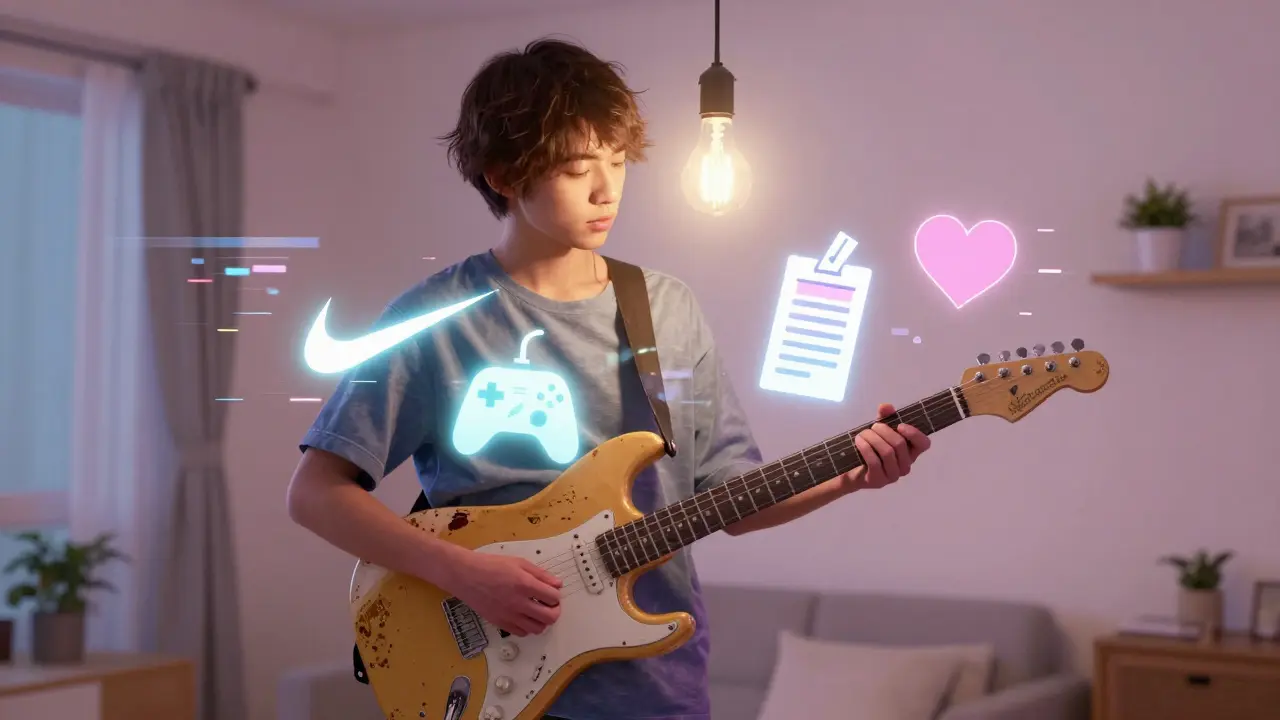
It’s not just about rock stars. The electric guitar shows up in ads, video games, and even political campaigns. Nike used a distorted riff in a 2000s ad to sell sneakers. Guitar Hero turned millions of kids into pretend rock gods. In 2016, a campaign in the U.S. used a modified version of ‘Smoke on the Water’ to promote voter registration. The riff was instantly recognizable-even people who didn’t know the song knew what it meant.
At weddings, the band plays ‘Sweet Child O’ Mine’ for the first dance. At high school graduations, the class plays ‘Enter Sandman’ as the lights dim. These aren’t random choices. They’re cultural codes. The electric guitar says: this moment matters. This moment is loud. This moment is unforgettable.
Why It Still Matters Today
Some say the electric guitar is dead. That streaming, autotune, and beats have replaced it. But look closer. Taylor Swift plays a Telecaster on stage. Olivia Rodrigo’s breakout hit ‘drivers license’ features a soaring electric guitar solo. Billie Eilish’s brother Finneas uses a modified Strat to build her dark, intimate sound. Even in pop, the electric guitar is making a quiet comeback-not as a relic, but as a tool for emotional punch.
Young musicians today don’t just learn guitar because it’s cool. They learn it because it’s real. It doesn’t need a program. It doesn’t need a loop station. Just fingers, strings, and a little courage. In a world of algorithms and filters, the electric guitar still sounds like a human voice-raw, imperfect, and alive.
What the Electric Guitar Taught Us
It taught us that sound can be rebellion. That silence can be louder than noise. That a piece of wood and wire can carry the weight of a generation’s hopes, fears, and dreams. It didn’t just change music-it changed how we see ourselves.
When you hear a power chord ring out, you’re not just hearing music. You’re hearing decades of kids who dared to be different. You’re hearing Hendrix screaming into the wind, Hendrix’s daughter learning to play his solos, a teenager in Tokyo practicing in her bedroom, a veteran in Ohio teaching his grandson how to bend a note.
The electric guitar didn’t just influence pop culture. It became part of its soul.
How did the electric guitar change the role of musicians in pop culture?
Before the electric guitar, musicians were often background players. The electric guitar turned guitarists into frontmen-stars who commanded stages, defined styles, and became symbols of rebellion. Artists like Jimi Hendrix and Eddie Van Halen weren’t just players; they were cultural icons whose image and sound shaped fashion, film, and youth identity.
Why is the electric guitar still relevant in modern pop music?
Even with digital production dominating charts, the electric guitar brings raw emotion that synths and samples can’t replicate. Artists like Olivia Rodrigo, Billie Eilish, and Taylor Swift use it to add grit, tension, or nostalgia to their songs. Its physicality-bending strings, feedback, live distortion-connects listeners to human imperfection, which feels more real in an age of automation.
Did the electric guitar only influence rock music?
No. While it’s most associated with rock, the electric guitar shaped blues, funk, punk, hip-hop (through sampling), country, and even pop. Bands like Talking Heads used it for rhythmic texture. Prince made it sing like a human voice. Even in modern trap beats, guitar licks are often sampled from 70s funk records. Its influence is everywhere, even when you don’t hear it directly.
What made the Fender Stratocaster so iconic?
The Stratocaster’s design was revolutionary: three single-coil pickups for tonal variety, a tremolo system for expressive vibrato, and a contoured body for comfort. Jimi Hendrix, Eric Clapton, and Stevie Ray Vaughan all used it to create signature sounds. Its versatility made it the go-to for genres from surf rock to metal. It wasn’t just a guitar-it became the default tool for innovation.
How did movies and TV shape the electric guitar’s image?
Shows and films turned guitarists into legends. Marty McFly playing ‘Johnny B. Goode’ in Back to the Future made the guitar a symbol of time-traveling cool. Almost Famous showed the chaos and passion behind rock stardom. Even comedies like Wayne’s World used air-guitaring to make the instrument a universal language of enthusiasm. These portrayals didn’t just entertain-they taught generations what the guitar represented: freedom, passion, and identity.