
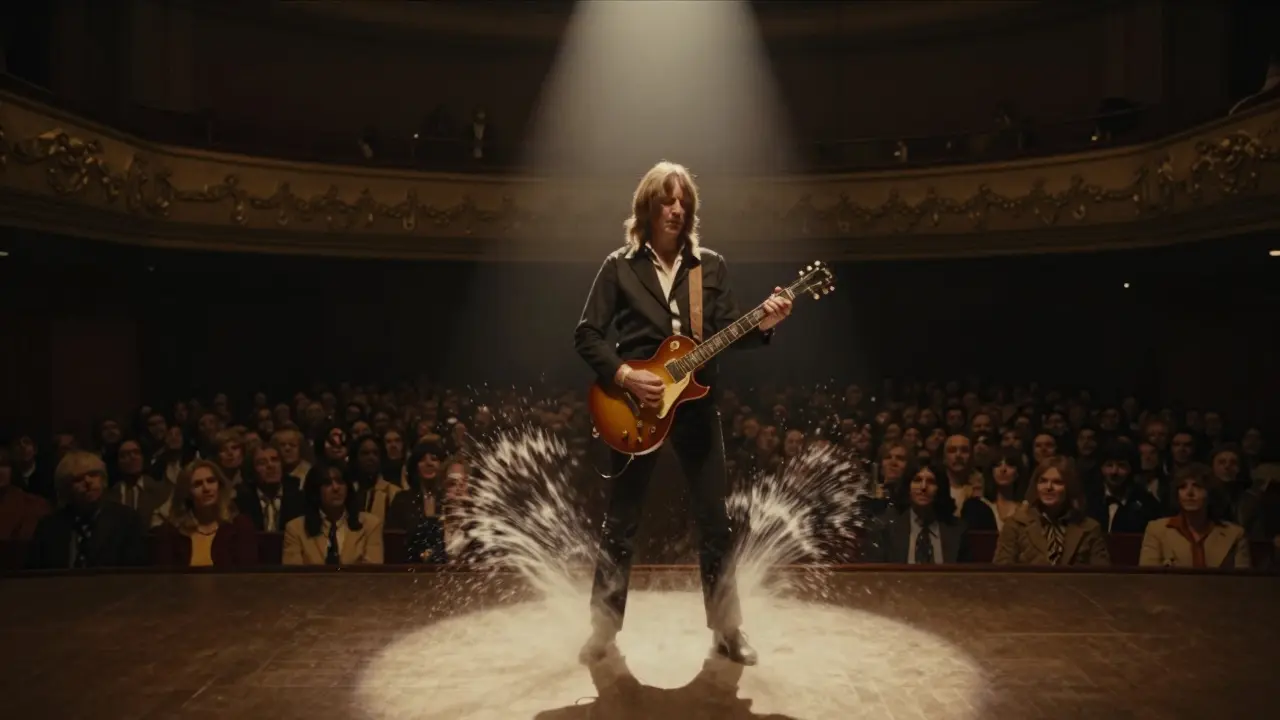
Think about the moment a guitar solo hits you like a lightning bolt - hair standing up, air guitar kicking in, heart pounding. Those aren’t just notes. They’re emotional explosions. In rock music, the guitar solo isn’t just a technical showoff. It’s the voice of rebellion, the scream of freedom, the sound of someone pushing past limits. Some solos changed how we hear music. Others became the soundtrack to our lives. Here are the most epic guitar solos in rock history - not because they’re the fastest, but because they matter.
"Stairway to Heaven" - Led Zeppelin
Jimmy Page didn’t just play a solo. He built a cathedral of sound. "Stairway to Heaven" starts quiet, almost whispering. By the time Page gets to the solo, the whole room is holding its breath. That solo isn’t about shredding. It’s about tension. Every note climbs, hesitates, then soars. It’s the emotional peak of a song that feels like a journey. Page used a Gibson Les Paul, a Fender Twin Reverb, and pure instinct. No backing tracks. No edits. One take. That’s why it still gives chills 50 years later. When Robert Plant sings "And she’s buying a stairway to heaven," and Page answers with that solo, you don’t just hear it - you feel it in your bones.
"Comfortably Numb" - Pink Floyd
David Gilmour’s solo on "Comfortably Numb" is the sound of isolation turned into beauty. Two solos. Both different. Both perfect. The first one is soft, aching - like someone trying to reach out but too numb to feel. The second? Pure fire. It starts with a single note that hangs in the air like a question. Then it builds. Slowly. Painfully. Until it explodes into a cry that doesn’t need words. Gilmour used a Hiwatt amp and a Fender Stratocaster. He didn’t play fast. He played with feeling. Each bend, each vibrato, each sustained note feels like a heartbeat. Roger Waters wrote the lyrics about detachment. Gilmour’s solo is the answer - the voice that comes through when words fail.
"Eruption" - Van Halen
Before Eddie Van Halen, guitar solos were melodic. After "Eruption," they became physics. This 1978 track, just 1:40 long, changed everything. No intro. No buildup. Just pure, uncut energy. Two-handed tapping. Harmonics. Whammy bar dives. He didn’t just play the guitar - he reprogrammed it. Eddie used his own modified Marshall amp and a custom-built guitar (the "Bumblebee"). He didn’t have formal training. He just heard something no one else could. That solo wasn’t meant to be copied. It was meant to be a wake-up call. Guitarists everywhere went back to their rooms and tried to figure out how he did it. Spoiler: they still can’t replicate it perfectly.
"Satisfaction" - The Rolling Stones
Keith Richards’ solo on "(I Can’t Get No) Satisfaction" is one of the most copied, misunderstood, and brilliant moments in rock. It’s not even a "solo" in the traditional sense. It’s a riff. But it’s so iconic, it became the solo. Richards played it on a Gibson Les Paul through a Vox AC30. He used a fuzz pedal (a Tone Bender) and accidentally recorded it with the amp’s volume cranked. The result? A buzzing, snarling hook that’s more memorable than the vocals. It’s the sound of frustration turned into a dance. No fancy scales. No arpeggios. Just one idea, played perfectly. That riff became the blueprint for rock’s attitude: simple, raw, and impossible to ignore.
"While My Guitar Gently Weeps" - The Beatles
George Harrison wrote this song. But the solo? That was Eric Clapton. And it’s one of the most emotionally devastating solos ever recorded. Harrison invited Clapton to play on the track because he felt his own playing wasn’t strong enough. Clapton didn’t overplay. He didn’t show off. He let the song breathe. His tone is warm, crying, almost human. He used a Fender Stratocaster and a Vox AC30. The solo doesn’t rush. It lingers. Each note feels like a sigh. It’s the sound of love, loss, and quiet resignation. This solo proves you don’t need speed to move people. Sometimes, silence between notes speaks louder than any run.
"Sweet Child O’ Mine" - Guns N’ Roses
Axl Rose’s voice gets the attention. Slash’s solo gets the legacy. That opening melody is unforgettable. But the solo? Pure magic. It starts with a simple, singable phrase - almost like a lullaby. Then it twists into something wild. Slash uses his signature Gibson Les Paul, a Marshall amp, and a tone so clean it cuts like glass. He doesn’t rely on effects. He relies on phrasing. Every note has weight. Every bend has soul. The solo builds like a conversation - tentative at first, then bold, then triumphant. It’s the sound of a teenager in love, scared, hopeful, and fearless all at once. It’s no wonder this solo is taught in every beginner guitar class - not because it’s easy, but because it’s pure emotion.
"Blackbird" - The Beatles (Acoustic Interpretation)
Wait - an acoustic solo? Yes. This one’s different. Paul McCartney’s fingerpicked solo on "Blackbird" isn’t loud. It’s not flashy. But it’s revolutionary. He used a 1964 Gibson J-160E and played with his thumb and fingers, creating a counterpoint melody that sounds like two guitars. The solo weaves around the chords like a bird in flight. It’s inspired by classical guitar, but it’s pure rock. McCartney didn’t have a teacher. He learned by listening to Django Reinhardt and studying how to make one instrument sound like a band. That solo proves you don’t need distortion or amplifiers to make something epic. Just patience, precision, and heart.
"Voodoo Child (Slight Return)" - Jimi Hendrix
Hendrix didn’t just play guitar. He turned it into a living thing. "Voodoo Child" is chaos with purpose. The solo starts with a feedback squeal - something most guitarists were taught to avoid. Hendrix made it a weapon. He used a Fender Stratocaster, a Fuzz Face, a Uni-Vibe, and a Marshall stack turned up to 11. He didn’t follow scales. He followed feeling. The solo screams, cries, laughs, and growls. It’s the sound of a man pushing the boundaries of what an instrument can do. That solo was recorded live in one take. No edits. No fixes. Just Hendrix, his guitar, and a room full of magic. Decades later, guitarists still try to replicate it. None have come close.
"Hotel California" - The Eagles
Don Felder and Joe Walsh traded solos on this track - and together, they created a masterpiece. The first solo is smooth, flowing, almost cinematic. The second? Dark, twisting, like a desert wind. Felder used a Fender Stratocaster. Walsh used a Gibson Les Paul. Their tones were different, but their timing was perfect. The solo isn’t about speed. It’s about space. The way the notes ring out in the mix, the way they echo into silence - it feels like driving through empty desert at night. The song’s lyrics paint a picture. The solos complete it. They’re not just guitar parts. They’re characters.
"Born to Run" - Bruce Springsteen
Clarence Clemons’ saxophone gets the spotlight. But the guitar solo? That’s Steven Van Zandt’s hidden gem. It doesn’t come until the bridge - a short, urgent burst of energy. Van Zandt used a Fender Telecaster through a Fender Twin. The solo is only 12 seconds long. But it’s the moment the song breaks free. It’s not pretty. It’s not polished. It’s raw, urgent, desperate. It sounds like someone running for their life. That solo doesn’t try to impress. It tries to survive. And that’s why it sticks with you.
"Layla" - Derek and the Dominos
Eric Clapton’s solo on "Layla" is the sound of heartbreak made audible. He recorded it after learning his lover was leaving him. The solo is long, winding, and full of pain. He used a Gibson Les Paul and a Fender Twin. The tone is thick, singing, almost weeping. The solo isn’t about technique. It’s about truth. Every bend, every slide, every note feels like a tear falling. Clapton didn’t write it to be famous. He wrote it because he had to. That’s why it still moves people. It’s not music. It’s confession.
"All Along the Watchtower" - Jimi Hendrix
Bob Dylan wrote this song. Hendrix reimagined it. His solo isn’t just an interpretation - it’s a transformation. Where Dylan’s version is folk and quiet, Hendrix’s is electric and explosive. The solo starts with a haunting, descending phrase. Then it spirals into a storm of feedback, bends, and harmonic squeals. He used a Fender Stratocaster and a wah pedal. The solo doesn’t follow the melody. It dances around it, teasing it, then crushing it. It’s the sound of a man taking something familiar and making it terrifyingly new. This solo turned a folk song into a rock anthem.
Why These Solos Matter
These solos aren’t famous because they’re hard. They’re famous because they’re human. They were played in moments of joy, grief, rage, or wonder. They weren’t designed to win guitar contests. They were born from real emotion. You can learn the notes. You can copy the fingerings. But you can’t fake the soul behind them. That’s why these solos still echo - decades later, in bedrooms, on stages, in cars with the windows down.
What Makes a Solo Epic?
Speed? No. Complexity? Not always. An epic solo has three things:
- Emotion - It makes you feel something, even if you don’t know why.
- Memorability - You hum it without thinking.
- Impact - It changed how others played, thought, or listened.
Some solos are short. Some are long. Some use effects. Some use nothing. But they all have one thing in common: they sound like a person speaking - not a machine.
Final Thought
Rock music doesn’t need 100-note runs to be powerful. Sometimes, one note - held just long enough - says everything. These solos aren’t just songs. They’re moments. And they’re still alive. Every time someone picks up a guitar and tries to play one, they’re not just learning a tune. They’re touching history.
What makes a guitar solo "epic"?
An epic guitar solo isn’t defined by speed or complexity. It’s defined by emotion, memorability, and impact. If it makes you feel something deep, you hum it without thinking, and it changed how others play - it’s epic. Solos like those in "Comfortably Numb" or "Stairway to Heaven" stick because they sound like human voices, not technical exercises.
Who played the fastest guitar solo in rock history?
Speed isn’t the point in rock solos. But if you’re asking, Eddie Van Halen’s "Eruption" and Randy Rhoads’ "Crazy Train" are often cited for their speed. Still, even those solos aren’t fast just for the sake of it. They’re fast because they serve the song. Modern shredders like John Petrucci or Steve Vai play faster, but none of those solos changed music the way the classics did.
Can you learn these solos on an electric guitar?
Absolutely. All of these solos were played on electric guitars, except "Blackbird," which is acoustic. But even if you start on an acoustic, you can transfer the phrasing and emotion to electric. The gear matters less than the feel. A cheap guitar with good technique will always sound more powerful than a $5000 guitar with no soul.
Why do some solos sound better than others?
It’s not about notes - it’s about space. Great solos know when to play and when to stop. They use silence like a weapon. Think of Gilmour’s "Comfortably Numb" solo - the pauses between notes are as important as the notes themselves. Also, tone matters. A good amp, a good guitar, and good dynamics make a huge difference. But none of that matters if the player doesn’t feel what they’re playing.
Are modern guitar solos as epic as the classics?
Modern solos are technically impressive - think Tom Morello, Gary Clark Jr., or St. Vincent. But they rarely reach the same cultural weight. Why? Because the classics were born in a time when guitar solos were the main event. Today, songs are built for streaming, not for live moments. Still, there are exceptions. Solos like the one in Tool’s "Lateralus" or Muse’s "Knights of Cydonia" come close. They’re rare, but they exist.