

There is a specific sound that stops people in their tracks. It’s not the distorted crunch of an electric rock riff or the polished sheen of a synthesizer. It’s the warm, woody resonance of a acoustic guitar a stringed musical instrument that produces sound through vibration of its strings transmitted to a soundboard without electronic amplification. This instrument has survived centuries of technological change because it does something no other tool can: it connects directly to human emotion through pure physics.
You don’t need a power outlet, a pedalboard, or a laptop to make music with an acoustic guitar. You just need wood, strings, and your hands. That simplicity is why it remains the most popular instrument in the world, from campfires in rural Kentucky to coffee shops in Tokyo. But beyond the romance, there is a fascinating engineering story behind why this box of wood sounds so good.
The Physics of Sound: How Wood Becomes Music
To understand why the acoustic guitar works, you have to look at how it moves air. When you pluck a string, it vibrates. Those vibrations travel down the neck to the bridge, which acts as a transducer. The bridge transfers that energy into the top plate, also known as the soundboard. The entire body of the guitar then acts as a resonator, amplifying those tiny movements into audible sound waves.
The choice of wood matters more here than in almost any other instrument. Luthiers-the craftsmen who build guitars-choose materials based on density, stiffness, and tonal properties. Spruce is the standard for the top because it is stiff yet lightweight, allowing it to vibrate efficiently. Mahogany, rosewood, and maple are common choices for the back and sides because they reflect sound back toward the player and audience with different colorations. Mahogany tends to be mid-range focused and punchy, while rosewood offers deep bass and sparkling highs.
This mechanical efficiency is why a well-built acoustic guitar can project over a noisy room without any electricity. The hollow body creates an air chamber that enhances certain frequencies, giving the instrument its characteristic warmth. If you press your ear against the soundhole while someone plays, you will hear the raw, uncolored tone before the body shapes it. That transformation is the magic of acoustic design.
Steel vs. Nylon: Choosing Your Voice
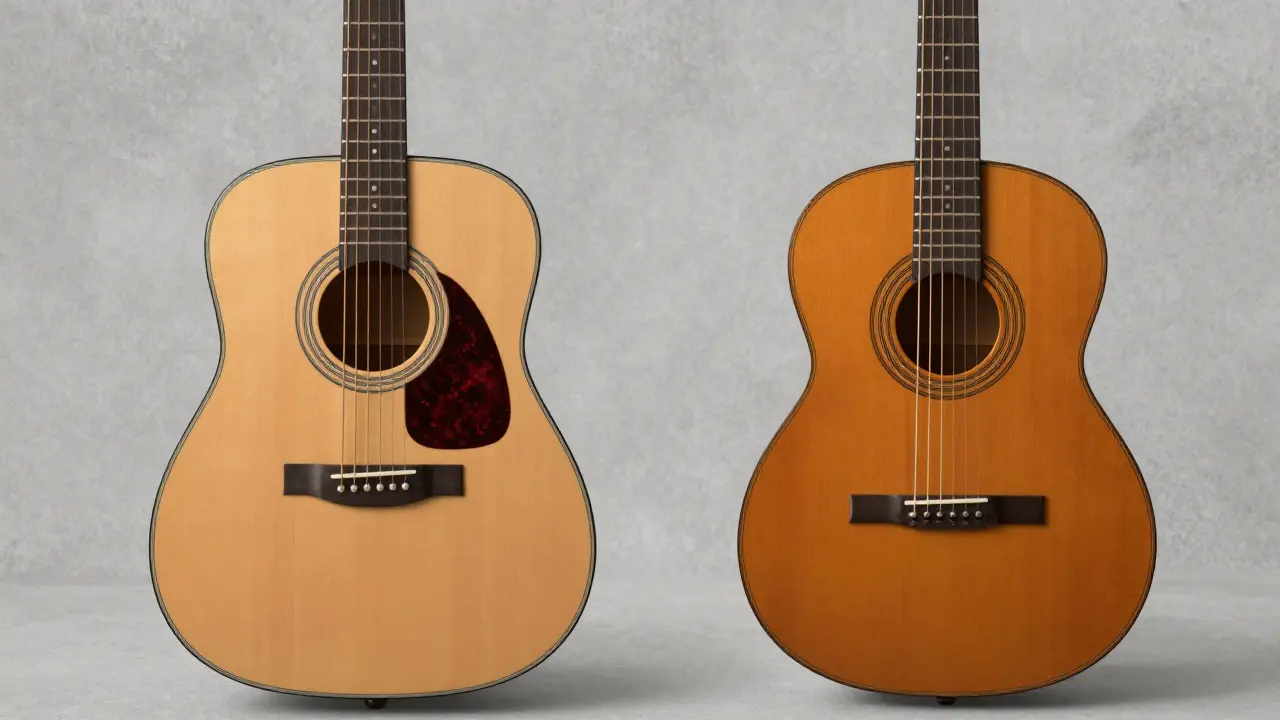
Not all acoustic guitars are created equal. The two main categories you will encounter are steel-string acoustics and nylon-string classics. Each serves a different musical purpose and feels distinct under your fingers.
Steel-string acoustic guitars acoustic guitars strung with metal wires designed for brighter tone and higher tension dominate folk, country, bluegrass, and pop music. They produce a bright, ringing tone with sustain that cuts through a mix. Brands like Martin and Gibson set the standard here. Martin guitars often feature dreadnought bodies, which are large and boxy, providing powerful bass response ideal for strumming. Gibson favors smaller, rounder shapes like the J-45 or OM models, which offer better balance for fingerstyle playing.
Classical guitars nylon-string acoustic guitars with wide necks designed for classical, flamenco, and Latin music, on the other hand, use nylon strings. These strings are softer on the fingertips, making them easier for beginners to learn on. The wider neck allows for complex fingerpicking techniques without strings getting in each other's way. The tone is mellower, darker, and less aggressive than steel strings. If you listen to Antonio Carlos Jobim or Francisco Tárrega, you are hearing the full potential of the nylon-string palette.
| Feature | Steel-String Acoustic | Nylon-String Classical |
|---|---|---|
| String Material | Phosphor Bronze or 80/20 Bronze | Nylon or Fluorocarbon |
| Tone Profile | Bright, Ringing, Punchy | Mellow, Warm, Soft |
| Neck Width | Narrower (1.65" - 1.75") | Wider (2" - 2.06") |
| Typical Genres | Folk, Country, Rock, Pop | Classical, Flamenco, Bossa Nova |
| Finger Comfort | Higher tension, more pain initially | Lower tension, gentler on fingers |
The Historical Journey: From Spain to Nashville
The acoustic guitar did not appear fully formed. Its roots stretch back to ancient civilizations, but the modern shape we recognize today emerged in 19th-century Spain. Antonio Torres Jurado, a Spanish luthier, is credited with designing the fan-bracing system used in classical guitars. His designs established the size, proportions, and internal structure that remain standard today.
In America, the story took a different turn. In the early 20th century, companies like C.F. Martin & Company began experimenting with X-bracing, a pattern of wooden braces inside the guitar that allowed for louder projection. As folk music grew in popularity during the Great Depression, musicians needed instruments that could compete with vocals in crowded rooms. The dreadnought body style, originally named after British battleships, became the industry standard because of its sheer volume.
The mid-20th century saw the rise of flat-top guitars in bluegrass and country music. Players like Earl Scruggs and Chet Atkins pushed the limits of what an acoustic guitar could do technically. Later, in the 1960s, singer-songwriters like Bob Dylan and Joan Baez brought the acoustic guitar to the forefront of cultural expression. It became a symbol of authenticity and protest, cementing its status as a timeless classic.
Essential Components: Anatomy of an Acoustic Guitar
Understanding the parts of your guitar helps you maintain it and choose the right one. Here are the key components you should know:
- Headstock: The top part of the guitar where the tuning pegs are located. It holds the tension of the strings.
- Nut: A small ridge at the base of the headstock that guides the strings onto the fretboard. Bone or Tusq are common materials.
- Fretboard: The surface where you press the strings to change pitch. Maple and rosewood are the most common woods.
- Bridge: Anchors the strings to the body and transfers vibration to the soundboard.
- Saddle: Sits on top of the bridge and supports the strings at the correct height (action).
- Soundhole: The circular opening in the center of the top plate that allows sound to escape.
Each part affects playability and tone. For example, the action-the distance between the strings and the fretboard-is crucial. High action makes the guitar hard to play, while low action can cause buzzing. Most players prefer a medium-low action for comfort without sacrificing clarity.

Caring for Your Instrument: Maintenance Tips
An acoustic guitar is sensitive to environmental changes. Wood expands and contracts with humidity and temperature fluctuations. Ignoring this can lead to cracked tops, warped necks, or lifted bridges.
Keep your guitar in a case when not in use, especially in dry climates. Use a humidifier if the relative humidity drops below 45%. In humid environments, silica gel packets help prevent swelling. Clean the finish regularly with a soft cloth to remove oils from your hands, which can degrade the varnish over time.
Change your strings every three to six months, depending on how often you play. Old strings lose their brightness and become difficult to tune. For steel-string guitars, phosphor bronze strings last longer and resist corrosion better than standard bronze. For classical guitars, replace the treble strings (nylon) separately from the bass strings (wound nylon) to save money.
Finding Your First Acoustic Guitar
If you are new to the instrument, start with a budget-friendly model from a reputable brand. Yamaha, Epiphone, and Fender offer solid entry-level guitars that hold their value and play well out of the box. Avoid unknown brands sold online with flashy finishes but poor construction. Playability is more important than looks.
Visit a local music store and try different body sizes. Dreadnoughts are great for strumming but might feel bulky if you are petite. Concert or parlor-sized guitars are comfortable for fingerstyle and smaller frames. Remember, the best guitar is the one you want to pick up and play every day.
Is an acoustic guitar harder to play than an electric guitar?
Yes, generally. Acoustic guitars have higher string tension and thicker strings, which require more finger strength to press down. Electric guitars have lower action and lighter strings, making chords easier to form. However, learning on an acoustic builds stronger fingers faster, so transitioning to electric later is easier.
How long does it take to learn basic chords on an acoustic guitar?
Most beginners can learn three to four open chords (like G, C, D, and Em) within two to four weeks of consistent practice. Mastering smooth transitions between chords takes about two to three months. Regular short sessions (15-20 minutes daily) are more effective than long, infrequent ones.
What is the difference between solid wood and laminate tops?
Solid wood tops are made from a single piece of timber and improve in tone as they age, becoming louder and richer. Laminate tops consist of thin layers of wood glued together. They are more durable and resistant to humidity changes but do not mature sonically. Solid tops are preferred by serious players, while laminates suit beginners or gigging musicians who need durability.
Can I use a classical guitar for rock or blues music?
You can, but it will sound different. Classical guitars have a softer attack and less sustain, which may not cut through a band mix as effectively as a steel-string acoustic. However, many artists like Mark Knopfler use nylon strings for a unique, percussive tone in rock and blues. It depends on the specific sound you are aiming for.
Why do acoustic guitars go out of tune frequently?
New strings stretch and settle over time, causing tuning instability. Additionally, acoustic guitars are sensitive to temperature and humidity changes, which affect the wood and string tension. Stretching new strings gently after installation and using a tuner regularly helps stabilize tuning. If the problem persists, the nut or tuning machines may need adjustment.