
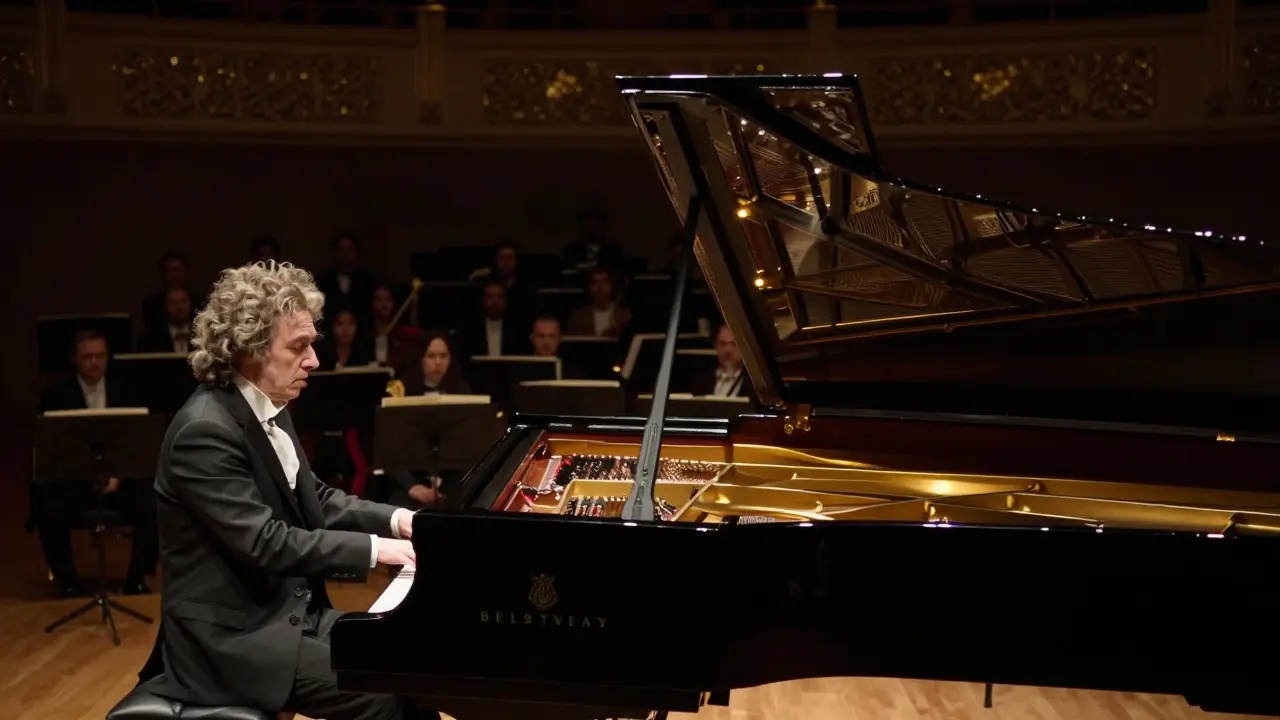
There’s something unforgettable about the moment a piano solo cuts through a full orchestra - like lightning in a storm. These aren’t just pieces of music; they’re emotional landscapes built with keys and strings. If you’ve ever felt your breath catch during the opening of Beethoven’s Emperor or been swept away by Rachmaninoff’s cascading arpeggios, you already know why piano concertos matter. They’re where solo brilliance meets orchestral power, and they’ve shaped centuries of musical expression.
Beethoven’s Piano Concerto No. 5 in E-flat Major, Op. 73 ("Emperor")
Beethoven’s Fifth Piano Concerto isn’t just famous - it’s legendary. Composed between 1809 and 1811, it was written during a time when Beethoven was losing his hearing. You can hear it in the music: a defiant, almost heroic voice refusing to be silenced. The opening isn’t a traditional introduction. Instead, the piano bursts in with three bold chords, as if saying, "I’m here, and I’m not waiting for permission."
The first movement, Allegro, is a storm of energy, with the orchestra and piano trading themes like rivals in a duel. The second movement, Adagio, is pure poetry - a quiet, meditative dialogue between piano and strings that feels like a prayer. Then, without pause, it flows into the Rondo: a brilliant, joyful finale that leaves you grinning. It’s no wonder this piece became known as the "Emperor" - even if Beethoven never named it that himself.
Rachmaninoff’s Piano Concerto No. 2 in C Minor, Op. 18
If Beethoven’s Fifth is a battle cry, Rachmaninoff’s Second is a love letter. Written in 1901 after years of depression and creative block, this concerto pulled Rachmaninoff out of darkness. It’s thick with emotion - romantic, melancholic, and wildly dramatic. The opening theme, played by the piano alone, is one of the most recognizable in classical music: slow, aching, and unforgettable.
The first movement builds slowly, like a wave gathering force. The second movement, with its lush string writing and haunting clarinet solos, feels like walking through a foggy Russian forest at dawn. And then there’s the finale - a whirlwind of energy, where the piano dances over thundering orchestral chords. This concerto doesn’t just demand technical skill; it demands soul. It’s why pianists still fight to master it, and why audiences still cry when they hear it live.
Mozart’s Piano Concerto No. 23 in A Major, K. 488
Mozart wrote 27 piano concertos - more than any other composer - but No. 23 stands out. Completed in 1786, it’s elegant, subtle, and surprisingly deep. Unlike the flashy concertos that came later, this one doesn’t shout. It whispers. And in its quietness, it’s more powerful.
The first movement opens with a gentle theme passed between the orchestra and piano, like two friends sharing a secret. The slow second movement, in F-sharp minor, is where the magic happens. It’s dark, tender, and full of longing - so much so that it’s often used in film scores to depict quiet grief. The final movement returns to lightness, but with a twist: playful, almost mischievous, like Mozart is winking at you. This concerto doesn’t need volume to move you. It just needs you to listen.
Chopin’s Piano Concerto No. 1 in E Minor, Op. 11
Chopin didn’t write for orchestras - he wrote for the piano, and the orchestra just followed along. His First Piano Concerto, written in 1830 when he was just 20, is a showcase of poetic brilliance. It’s not about power. It’s about color.
The opening movement is full of flowing melodies that feel like they’re improvised, even though every note is carefully placed. The slow movement, Larghetto, is one of the most beautiful slow movements ever written - a night-time serenade for piano and strings, with delicate ornamentation that sounds like moonlight on water. The finale is a Polish polonaise, lively and proud, with the piano spinning out intricate patterns while the orchestra pounds out a dance rhythm. This concerto isn’t meant to impress with technique alone. It’s meant to make you feel something deep.
Prokofiev’s Piano Concerto No. 3 in C Major, Op. 26
Prokofiev’s Third Concerto is like a rollercoaster with a sense of humor. Written in 1913 and revised in 1921, it’s sharp, rhythmic, and full of surprises. The opening is deceptively simple - a childlike theme played by the piano - but it quickly twists into something darker and more complex.
The first movement is a whirlwind of energy, with sudden shifts in mood and unexpected accents. The second movement is a scherzo that feels like a cartoon come to life - quick, bouncy, and full of clanging percussion. The finale is a whirlwind of driving rhythms and dazzling fingerwork. This concerto doesn’t ask for sympathy. It asks for attention. And once you’ve heard it, you won’t forget the way it snaps, snaps, snaps like a whip.
Tchaikovsky’s Piano Concerto No. 1 in B-flat Minor, Op. 23
This concerto almost didn’t happen. When Tchaikovsky first played it for his teacher, Nikolai Rubinstein, Rubinstein called it "unplayable" and "vulgar." Tchaikovsky didn’t change a note. He premiered it anyway - in Boston, in 1875 - and it became an instant sensation.
The opening is unmistakable: a massive, sweeping chord from the orchestra, then a thunderous piano flourish that feels like the sun rising. The main theme - bold, sweeping, and unforgettable - is one of the most quoted in all of classical music. The slow movement is lyrical, almost folk-like, with a solo for English horn that feels like a distant memory. The finale is a wild, dancing tarantella that leaves the audience breathless. It’s not subtle. It’s not quiet. But it’s unforgettable.
Why These Six Matter
These six concertos aren’t just the "best" - they represent different sides of what the piano can do. Beethoven shows its power. Rachmaninoff shows its heart. Mozart shows its grace. Chopin shows its poetry. Prokofiev shows its wit. Tchaikovsky shows its fire.
Each one changed how composers thought about the piano. Before these, the piano was mostly a solo instrument or a supporting voice. After them, it became a force - equal to the orchestra, capable of leading it, challenging it, and singing over it.
Listening to them isn’t about checking off a list. It’s about feeling the evolution of a single instrument across a century of human emotion. You don’t need to know the keys or the time signatures. You just need to let yourself be moved.
Where to Start
If you’re new to piano concertos, start with the ones that feel most human:
- For emotion: Rachmaninoff’s Second
- For beauty: Mozart’s No. 23
- For drama: Tchaikovsky’s First
Then work your way into the others. Don’t rush. Let each one settle in. Play them in the dark. Play them on repeat. Let them become part of your inner soundtrack.
What makes a piano concerto different from a solo piano piece?
A piano concerto is written for piano and orchestra, with the piano as the solo voice interacting with - and sometimes competing with - the full ensemble. Solo piano pieces, like Chopin’s nocturnes or Debussy’s preludes, are meant to stand alone without orchestral support. In a concerto, the dialogue between piano and orchestra creates tension, contrast, and drama that solo works don’t have.
Are there modern piano concertos worth listening to?
Yes. While the great 19th-century concertos dominate the repertoire, modern composers like Samuel Barber, Leonard Bernstein, and more recently, Jennifer Higdon and Thomas Adès have written powerful concertos. Higdon’s Piano Concerto (2008) blends jazz rhythms with orchestral textures, while Adès’s Concerto for Piano and Orchestra (2018) is dark, intricate, and rhythmically complex. They don’t replace the classics - they expand them.
Do I need to read music to appreciate piano concertos?
Absolutely not. Many people connect with these pieces without knowing a single note. What matters is how the music makes you feel - whether it stirs joy, sorrow, awe, or longing. You don’t need to understand harmony or form to be moved by Rachmaninoff’s melodies or Beethoven’s intensity. Just listen with your heart.
Which recording should I listen to first?
For Beethoven’s "Emperor," try Martha Argerich with the Berlin Philharmonic. For Rachmaninoff’s Second, Vladimir Ashkenazy’s 1975 recording with the London Symphony is a benchmark. Mozart’s No. 23 is beautifully captured by Murray Perahia with the English Chamber Orchestra. These performances are widely available on streaming platforms and have stood the test of time for their emotional depth and technical clarity.
Why do pianists keep returning to these concertos?
Because they’re never finished. Each time a pianist plays them, they uncover something new - a subtle dynamic shift, a hidden phrase, a moment of silence that speaks louder than the notes. These concertos are like deep wells: the more you draw from them, the more they give back. They challenge technique, but they also demand honesty. That’s why they endure.