
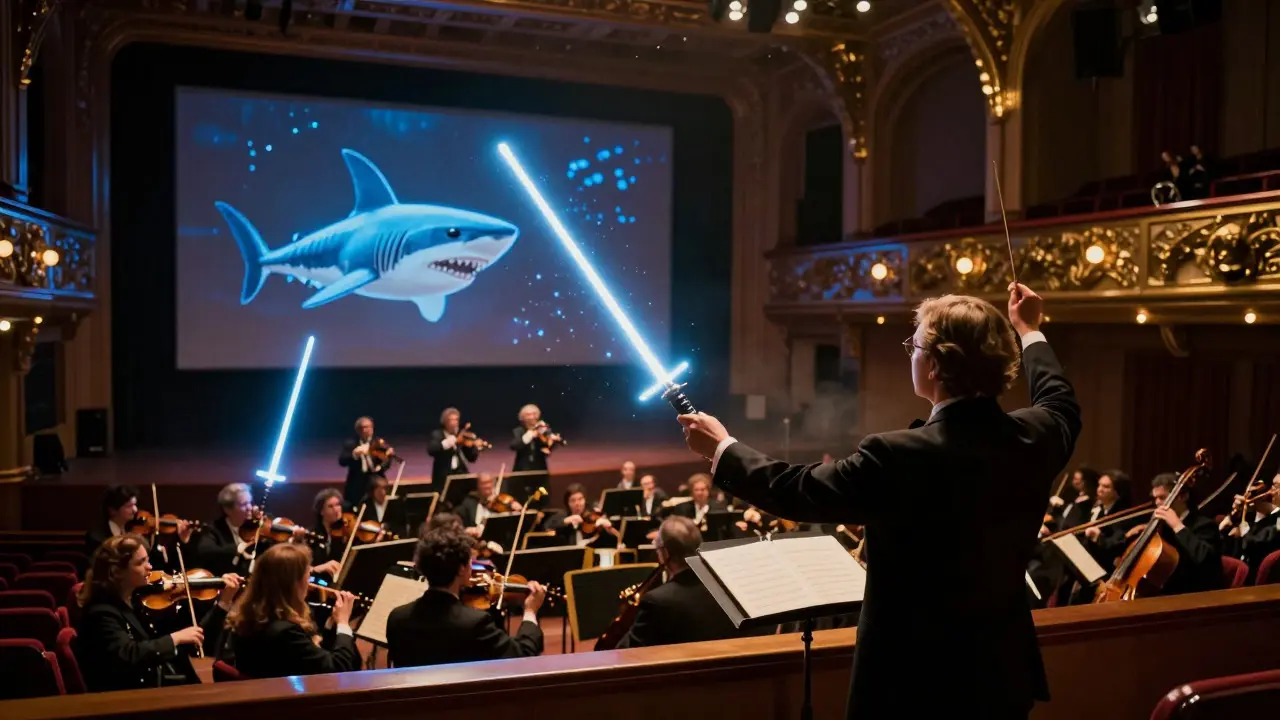
Think about the last time a movie made you cry, hold your breath, or feel a surge of adrenaline. Now, imagine that same scene playing with a generic pop song or, worse, silence. The magic would vanish instantly. This isn't just coincidence; it is the deliberate power of classical music in cinema, where orchestral traditions from centuries ago are repurposed to manipulate human emotion on screen. From the thunderous brass of war epics to the delicate strings of romantic dramas, the language of the symphony hall has become the universal vocabulary of the silver screen.
It might surprise you to learn that this relationship wasn't always so seamless. Early cinema was silent, relying on live pianists or organists to improvise accompaniment. But as technology evolved, filmmakers realized they could borrow the emotional shorthand already established by composers like Beethoven, Tchaikovsky, and Wagner. They didn't just want background noise; they wanted the weight of history and the complexity of human feeling that only a full orchestra could provide. Today, whether it's a blockbuster superhero film or an independent drama, classical techniques remain the backbone of cinematic storytelling.
The Emotional Shortcut of Orchestration
Why do directors reach for violins and cellos instead of synthesizers? It comes down to immediate recognition. Over hundreds of years, Western audiences have been conditioned to associate specific musical structures with specific feelings. A minor key often signals sadness or tension. Fast tempos create anxiety or excitement. Major keys suggest triumph or joy. When a filmmaker uses these tools, they are speaking a language the audience already knows fluently.
Consider the use of leitmotifs, a technique perfected by Richard Wagner in his operas. A leitmotif is a recurring musical phrase associated with a particular character, idea, or situation. In cinema, this allows composers to tell us who is thinking about whom, even if no words are spoken. Think of the iconic two-note motif in Jaws is a thriller directed by Steven Spielberg that uses a simple, repetitive cello and bass line to represent the approaching shark, creating dread without showing the monster. That sound doesn't just mean "shark"; it means imminent danger. It triggers a primal fear response because the low frequencies mimic the rumble of something large and threatening. By using classical compositional techniques, the score does the heavy lifting for the director, guiding the viewer’s emotional journey without a single line of dialogue.
This emotional manipulation is subtle but powerful. If a scene shows a character walking down a street, the image alone is neutral. Add a swelling string section, and suddenly we feel their loneliness or determination. Swap those strings for dissonant brass, and we sense impending violence. The classical orchestra provides a palette of colors that electronic instruments often struggle to replicate with the same organic warmth and dynamic range.
From Opera to Action: Adapting Historical Forms
The bridge between the concert hall and the movie theater was built by pioneers who understood both worlds. One cannot discuss this topic without mentioning Richard Wagner is a German composer whose concept of 'Gesamtkunstwerk' (total work of art) influenced how music integrates with visual storytelling in film. Wagner believed that music, drama, and visuals should be unified. Filmmakers adopted this philosophy, realizing that music shouldn't just accompany the action; it should drive it.
In the mid-20th century, composers like Erich Wolfgang Korngold is an Austrian-American composer who brought the lush, romantic style of late Romantic opera to Hollywood swashbucklers like 'The Sea Hawk' and 'The Adventures of Robin Hood'. took melodies directly from the Romantic era and adapted them for adventure films. The sweeping, heroic themes in movies like *King Kong* (1933) owe a direct debt to the grandeur of 19th-century symphonies. These scores taught audiences that big emotions require big sounds. The use of full orchestras-sometimes exceeding 100 musicians-created a wall of sound that immersive theaters could barely contain.
Later, in the 1970s and 80s, John Williams is an American composer known for blending classical leitmotif techniques with modern orchestration to create some of the most recognizable themes in film history, including Star Wars and Jurassic Park. revived these traditions. His work on *Star Wars* wasn't just background music; it was a symphonic epic in its own right. He used traditional orchestral sections to define characters: bold brass for heroism, woodwinds for mystery, and strings for romance. By doing so, he proved that classical forms were not outdated relics but living, breathing tools that could evolve with popular culture.
Modern Blockbusters and the Symphonic Tradition
Even in an age dominated by hip-hop, electronic dance music, and rock, the biggest blockbusters still rely heavily on classical instrumentation. Why? Because scale demands scale. When a spaceship explodes or a dragon attacks, a drum machine simply doesn't carry enough physical weight. The human ear perceives the acoustic resonance of a double bass or a timpani drum differently than synthesized equivalents. There is a visceral, physical reaction to low-frequency acoustic sounds that screens can't fully replicate.
Take the Harry Potter is a film series composed by John Williams and others, which uses distinct musical themes for houses, spells, and characters to build a cohesive auditory world. franchise. Each Hogwarts house has its own musical identity, rooted in classical harmonic structures. Gryffindor’s theme is bold and brass-heavy, signaling courage. Slytherin’s theme is smoother, more serpentine, using woodwinds and lower strings to suggest cunning. These aren't random choices; they are calculated applications of classical color theory applied to sound. The audience subconsciously registers these cues, deepening their immersion in the story.
Similarly, the Lord of the Rings is a trilogy scored by Howard Shore, who incorporated folk instruments alongside a massive orchestra to reflect the mythological scope of J.R.R. Tolkien's Middle-earth. trilogy by Howard Shore demonstrates how classical composition can handle complex narrative layers. Shore wrote over 100 distinct themes for the trilogy, weaving them together like a giant symphony. The use of choirs, inspired by Gregorian chants and medieval hymns, added a spiritual, ancient quality that synthetic sounds couldn't achieve. This approach showed that classical music isn't just about melody; it's about texture, atmosphere, and historical authenticity.
The Psychology Behind the Notes
To understand why classical music works so well in cinema, we have to look at psychology. Studies in neuroscience show that music activates multiple areas of the brain simultaneously, including those responsible for memory, emotion, and motor control. When a film score uses familiar classical patterns, it taps into what psychologists call "musical expectancy." We anticipate where a melody will go. When the composer fulfills that expectation, we feel satisfaction. When they subvert it, we feel surprise or tension.
This is crucial for suspense. In horror films, composers often use high-pitched strings played with a bow pressed hard against the fingerboard-a technique called sul ponticello-to create eerie, glassy sounds. This mimics the sound of insects or wind, triggering our evolutionary alert systems. Conversely, warm, slow-moving adagios in major keys release oxytocin, the bonding hormone, making us feel safe and connected to characters. Classical music gives filmmakers precise control over these neurochemical responses.
Moreover, classical music lacks lyrics. This is a significant advantage in cinema. Lyrics compete with dialogue for the viewer's attention. Instrumental music sits in the background, coloring the scene without distracting from the plot. It allows the audience to focus on the actors' faces and the director's framing while still feeling the intended emotion. It is the perfect invisible support system.
Preserving Craft in a Digital Age
While digital audio workstations (DAWs) have made composing faster and cheaper, there is a growing appreciation for the irreplaceable value of live orchestras. Many top studios now record their scores with real musicians in legendary halls like Abbey Road Studios in London or Eastman Scoring Stage in Los Angeles. The slight imperfections of human performance-the breath before a note, the slight variation in tempo-add humanity to the soundtrack. Algorithms can mimic perfection, but they struggle to mimic soul.
This resurgence highlights a broader trend: audiences crave authenticity. In a world saturated with artificial content, the raw power of 80 people playing violins in unison feels genuine. It connects the modern viewer to a long lineage of artistic expression. When you hear the opening chords of a classic film score, you are hearing the culmination of centuries of musical evolution, tailored specifically to move you.
| Feature | Classical/Orchestral | Electronic/Synthetic |
|---|---|---|
| Emotional Depth | High nuance through dynamics and timbre | Often relies on repetition and rhythm |
| Historical Context | Evokes tradition, epic scale, and heritage | Suggests futurism, technology, or urban settings |
| Dynamic Range | Extreme contrast from whisper-quiet to deafening loud | Limited by compression and digital ceilings |
| Production Cost | High (requires studio, musicians, conductors) | Low to Moderate (software-based) |
| Audience Perception | Perceived as premium, serious, and immersive | Perceived as modern, cool, or stylized |
The Future of Cinematic Sound
As we move further into the 2020s, the line between genres continues to blur. Hybrid scores that mix orchestral strings with electronic beats are becoming common. However, the core principles remain unchanged. The need for emotional clarity, narrative support, and atmospheric depth ensures that classical music will never disappear from cinema. It may change form, adapting to new technologies and cultural shifts, but its fundamental role as the heartbeat of the film experience is secure.
For viewers, understanding this connection adds a new layer of enjoyment. Next time you watch a film, try turning off the dialogue and listening only to the music. Notice how the strings swell during moments of tension, or how the brass announces a hero's arrival. You'll start to hear the invisible hand of the composer, guiding your emotions with the timeless power of classical music. It is not just background noise; it is the soul of the story.
Why do movies use classical music instead of popular songs?
Movies use classical music because it offers greater emotional flexibility and dynamic range. Unlike pop songs, which have fixed lyrics and structures, instrumental classical pieces can be edited, extended, or shortened to match the pacing of a scene. Additionally, classical music avoids competing with dialogue, allowing the audience to focus on the story while still feeling the intended mood.
What is a leitmotif in film music?
A leitmotif is a recurring musical theme associated with a specific character, place, or idea. Originating in opera, it helps audiences identify connections within the story. For example, when a villain appears, their unique musical theme plays, signaling danger even before they are seen on screen. This technique builds subconscious associations and enhances narrative cohesion.
How does orchestral music affect the viewer's brain?
Orchestral music stimulates multiple brain regions linked to emotion, memory, and anticipation. Low-frequency instruments like cellos and tubas can trigger physiological responses such as increased heart rate or goosebumps, enhancing feelings of awe or fear. Familiar harmonic progressions create a sense of resolution or tension, directly influencing how viewers interpret the visual action.
Are all movie scores considered classical music?
Not necessarily, but many modern film scores are rooted in classical traditions. While some scores use electronic or jazz elements, those that utilize full orchestras, traditional instrumentation, and symphonic structures are closely related to classical music. Composers often blend styles, but the foundational techniques of harmony, counterpoint, and orchestration come from the classical canon.
Who are some famous composers who bridged classical music and cinema?
Key figures include Erich Wolfgang Korngold, who introduced Romantic opera styles to Hollywood; John Williams, who revitalized the symphonic score with Star Wars and Indiana Jones; and Hans Zimmer, who blends orchestral textures with electronic innovation. These composers trained in classical traditions but adapted them to serve the unique needs of visual storytelling.