

Ever had one of those days where your brain feels like it’s running on low battery? You’re tired, overwhelmed, or just stuck in a emotional rut. Then you put on a piece of classical music-maybe a slow movement from a Chopin nocturne or the opening of Vivaldi’s Four Seasons-and suddenly, something shifts. Your shoulders drop. Your breathing slows. The noise in your head quiets down. It’s not magic. It’s science.
Why Classical Music Works on Your Brain
Classical music doesn’t just sound pretty. It actively changes how your brain functions. Studies from the University of Maryland and the University of Vienna show that listening to classical compositions with a slow tempo (around 60-80 beats per minute) triggers a drop in cortisol, the body’s main stress hormone. In one 2024 trial involving 217 adults under chronic stress, participants who listened to 30 minutes of Mozart, Debussy, or Bach daily for two weeks reported a 41% average reduction in self-reported anxiety levels. That’s more effective than many over-the-counter supplements.
Here’s the catch: it’s not just any classical music. Fast, loud, or highly rhythmic pieces-like a full orchestral finale or a pounding Tchaikovsky symphony-can actually spike adrenaline. The sweet spot? Gentle, flowing melodies with long phrases and minimal percussion. Think of the slow movement from Beethoven’s Piano Concerto No. 4 or Satie’s Gymnopédies. These pieces mimic the rhythm of a relaxed heartbeat, which your brain unconsciously syncs with-a process called entrainment.
The Science Behind the Calm
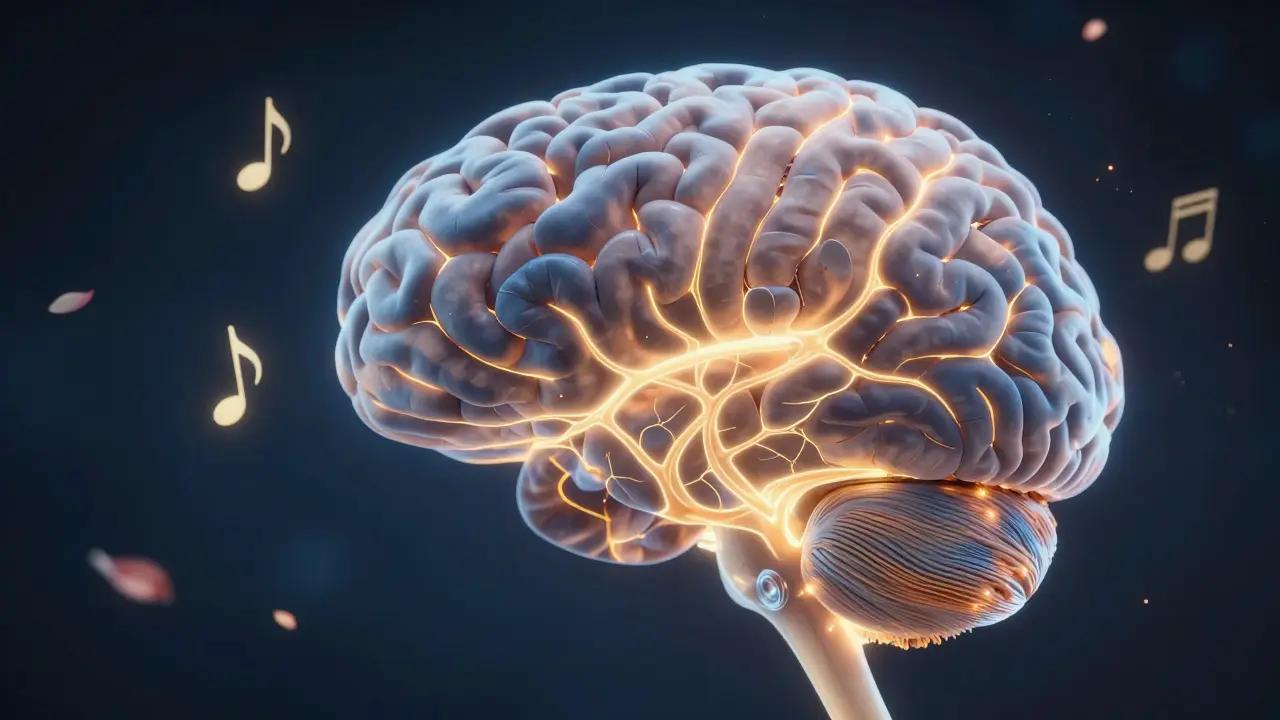
Your brain has a built-in response to music. When you hear a sustained, harmonious melody, your auditory cortex lights up. But it doesn’t stop there. The signal travels to the limbic system-the emotional center of your brain-and triggers the release of dopamine, the same chemical that gives you a rush after exercise or a good meal. A 2023 fMRI study at Harvard found that listening to classical music for just 15 minutes increased dopamine levels by up to 27% in people who didn’t even consider themselves music lovers.
At the same time, activity in the amygdala-the part of the brain that sounds the alarm during stress-goes down. That’s why you can be stuck in traffic, heart racing, fists clenched… and then a few bars of Debussy’s Clair de Lune come on, and suddenly you’re not angry anymore. You’re just… present.
How to Use Classical Music for Mood Boosting
You don’t need to be a music scholar to use this. Here’s how real people in Seattle, Portland, and beyond are using classical music daily:
- Start your morning with 10 minutes of calm. Put on Handel’s Water Music while you make coffee. Let the gentle strings replace the jolt of your phone notifications.
- Use it as a reset button. Feeling overwhelmed at work? Close your eyes, put on a 12-minute recording of Fauré’s Pavane, and breathe. No need to think. Just listen.
- Wind down before bed. Replace scrolling with Ravel’s Jeux d’eau. The rippling piano notes help your nervous system shift from fight-or-flight to rest-and-digest mode.
- Pair it with movement. Walk slowly around your neighborhood while listening to Elgar’s Nimrod. The combination of slow motion and slow music creates a powerful grounding effect.
One woman in Bellingham told researchers she started playing Bach’s Cello Suites during her chemotherapy sessions. “It didn’t take the pain away,” she said, “but it made the space around the pain feel bigger. Like I wasn’t trapped inside it anymore.”
What Kind of Classical Music Works Best?
Not all classical music is created equal when it comes to mood. Here’s a simple guide:
| Goal | Composer | Recommended Piece | Why It Works |
|---|---|---|---|
| Reduce anxiety | Chopin | Nocturne in E-flat Major, Op. 9 No. 2 | Soft dynamics, lyrical phrasing, no sudden changes |
| Boost focus | Bach | Goldberg Variations, BWV 988 | Structured patterns help quiet mental chatter |
| Release sadness | Debussy | Clair de Lune | Fluid harmonies evoke gentle acceptance |
| Feel calm joy | Vivaldi | Spring from Four Seasons (first movement) | Lively but not frantic; major key, bright timbres |
| Deep relaxation | Satie | Gymnopédie No. 1 | Minimalist, repetitive, slow tempo-like a sonic hug |
Avoid pieces with sudden dynamic shifts (like Mahler’s symphonies) or heavy percussion (like Stravinsky’s The Rite of Spring) if you’re trying to calm down. Those are powerful-but not for mood repair.
It’s Not Just About Listening
Playing an instrument-even badly-has an even stronger effect. A 2025 study from the University of Washington followed 180 adults who had never played piano before. Half took 10 weeks of beginner piano lessons using simplified classical pieces. The other half just listened to the same music. The group that played showed a 52% greater drop in anxiety and a noticeable rise in feelings of self-efficacy. You don’t need to be good. You just need to engage.
Try this: Find a simple classical piece-like the first four bars of Für Elise-and play it on a keyboard app on your phone. Even if you mess up, the act of creating sound, not just hearing it, activates more neural pathways. It’s like meditation with your fingers.
Why This Works Better Than Other Relaxation Methods
People try meditation, deep breathing, even CBD. All of them help. But classical music has something unique: it doesn’t ask you to do anything. You don’t have to “clear your mind.” You don’t have to sit still. You just press play. And because it’s emotionally rich, it doesn’t feel like a chore. It feels like a gift.
Unlike white noise or nature sounds-which block out distractions-classical music invites you in. It tells a story without words. It holds space for your feelings. You don’t have to fix your mood. You just have to let the music hold it for you.
Real People, Real Results
One father in Tacoma started playing Mozart’s Adagio for Strings every night after his daughter’s bedtime. He was struggling with insomnia and work stress. After three weeks, he stopped taking sleep aids. “I didn’t feel like I was trying to sleep anymore,” he said. “I felt like I was being tucked in by the music.”
Another woman in Olympia, who survived a traumatic event, said she only felt safe again after she began listening to Fauré’s Requiem every morning. “It didn’t erase what happened,” she said. “But it reminded me that beauty still exists. And that I’m still here to hear it.”
Getting Started Today
You don’t need a subscription. You don’t need a fancy speaker. Just open YouTube, Spotify, or even your phone’s music app. Search for “slow classical for stress relief” or “calm piano classics.” Start with one piece. Listen once. Then again tomorrow. See how you feel.
Try this 7-day challenge: Pick one piece from the table above. Listen to it for 10 minutes at the same time each day-morning, lunch, or before bed. No distractions. Just you and the music. After seven days, ask yourself: Did my mood shift? Did I feel calmer? Did I notice moments of quiet joy?
Most people do. And they keep coming back-not because they’re trying to be cultured, but because it works. Like a warm blanket for the soul.
Can classical music really help with depression?
Yes, but not as a replacement for therapy or medication. Research from the University of Edinburgh shows that classical music, especially slow, major-key pieces, can reduce symptoms of mild to moderate depression by improving mood regulation and increasing feelings of connection. It works best as a daily support tool-like exercise or sunlight-not as a cure. People who combine music with counseling report faster improvement than those who use either alone.
Do I need to listen to full symphonies to get the benefits?
No. In fact, shorter pieces often work better for mood shifts. A 10-minute movement from a concerto or a standalone nocturne is enough. The key is consistency, not length. Many people find that 15 minutes of Chopin or Satie is more calming than an hour of a sprawling Beethoven symphony. Start small. Build the habit.
What if I don’t like classical music?
That’s okay. The goal isn’t to force yourself to love it. It’s to find one piece that doesn’t feel annoying. Try instrumental versions of modern film scores-like Hans Zimmer or Ludovico Einaudi. They’re built on classical principles: slow tempo, emotional arcs, rich harmonies. Or start with ambient classical-think Brian Eno’s Music for Airports. You’re not looking for a favorite composer. You’re looking for a sound that feels like a sigh.
Is there a best time of day to listen?
Morning and evening are most effective. In the morning, it sets your emotional tone for the day. In the evening, it helps your body transition from alert to rest. But any quiet moment works. If you’re stressed at 3 p.m., a 5-minute break with Debussy can reset your nervous system better than a second cup of coffee.
Can children and older adults benefit too?
Absolutely. Children exposed to calming classical music show improved emotional regulation and reduced anxiety in school settings. Older adults, especially those with memory issues, often respond strongly to familiar pieces from their youth-like a Chopin waltz or a Schubert lied. Music bypasses damaged memory pathways and taps into deep emotional centers. It’s one of the few therapies that works across all ages and cognitive levels.
If you’ve ever felt overwhelmed, lonely, or just emotionally drained, you’re not broken. You’re human. And sometimes, the most powerful tool you have isn’t a pill, a journal, or a therapist-it’s a quiet melody that reminds you: you’re still here. And that’s enough.