

Ever wonder why you can’t get enough of lo-fi hip hop beats while your friend obsesses over black metal? It’s not random. It’s not just about mood. It’s about subgenres-the tiny, detailed branches of music that split off from bigger genres and start speaking directly to your brain. Subgenres don’t just describe sound; they define identity, community, and emotional response. And if you’ve ever felt a deep connection to a song that no one else seems to understand, you’ve felt the power of a subgenre.
What Exactly Is a Subgenre?
A subgenre is a smaller, more specific style that evolves from a broader genre. Think of genres as big trees-rock, hip hop, electronic-and subgenres as the individual branches growing off them. Each branch develops its own rules: tempo, instrumentation, production techniques, lyrical themes, even fashion. A song labeled ‘post-punk’ isn’t just ‘punk but slower.’ It’s darker, more atmospheric, often using reverb-drenched guitars and detached vocals. It carries the DNA of punk but adds its own emotional weight.
Subgenres form when artists push boundaries, fans create communities around niche sounds, and technology changes how music is made. The rise of affordable home recording in the 2010s didn’t just make music easier to produce-it birthed entire subgenres like bedroom pop and chillwave. Suddenly, someone in a basement in Ohio could make music that sounded like a faded VHS tape from 1987, and thousands of strangers online would feel like it was made just for them.
How Subgenres Shape Your Musical Taste
Your taste in music isn’t random. It’s shaped by exposure, emotion, and identity. Subgenres act like filters. You don’t just like ‘pop’-you like ‘hyperpop,’ with its distorted vocals, glitchy beats, and neon-lit chaos. You don’t just like ‘metal’-you like ‘djent,’ with its palm-muted polyrhythms and low-tuned chugs that feel like a mechanical heartbeat.
Studies in music psychology show that people don’t just listen to music they like-they listen to music that reflects who they are or who they want to be. Subgenres give you a label to wear. Saying you listen to ‘slowcore’ isn’t just about the slow tempos and melancholy guitars. It’s saying you value quiet intensity, emotional honesty, and solitude. It’s a cultural signal.
Take ‘indie rock’ as an example. In the 1990s, it meant guitar-driven music released on small labels, away from mainstream radio. Today, ‘indie rock’ has splintered into dozens of subgenres: ‘emo revival,’ ‘math rock,’ ‘twee pop,’ ‘post-rock.’ Each one has a different emotional core. Emo revival is raw, confessional, screamed lyrics over trembling chords. Math rock is complex, rhythmic, almost mathematical. Twee pop is sweet, innocent, childlike. You don’t just choose one-you choose the version of yourself that each one represents.
Examples of Subgenres and What They Reveal
Here are five subgenres that show how deeply they connect to identity:
- Lo-fi hip hop: Characterized by muffled drums, vinyl crackle, and looped jazz samples. It’s not meant to be danced to-it’s meant to be studied to, cried to, or just stared out the window to. It’s the soundtrack for people who need calm in a noisy world.
- Blackgaze: A mix of black metal’s shrieking vocals and blast beats with shoegaze’s wall of reverb. It’s aggressive yet beautiful, chaotic yet meditative. Fans often describe it as ‘emotional catharsis through noise.’
- Trap metal: Combines the 808s and hi-hats of trap with the distorted guitars and growls of metal. It’s aggressive, futuristic, and often tied to online subcultures. Artists like Pop Smoke and Bones built followings by blending these sounds in ways no one expected.
- Chamber pop: Uses orchestral instruments-strings, horns, harpsichords-within pop song structures. Think of The Decemberists or Belle and Sebastian. It’s intellectual, lush, and deeply nostalgic. It appeals to people who find joy in complexity and detail.
- Drill music: Originated in Chicago, then exploded in London. Dark, minimalist beats, violent street narratives, cold vocal delivery. It’s not just music-it’s documentation. Listeners connect with its raw realism, even if they’ve never lived it.
Each of these subgenres has a sound, a scene, and a story. You don’t just hear them-you feel them in your bones. That’s why you can instantly recognize a song as ‘chillwave’ or ‘nu-metal’ even if you’ve never heard it before.
Technology’s Role in Subgenre Explosion
Before the internet, subgenres formed slowly. You had to live near a record store that carried obscure imports, or know someone who traded cassettes. Now, algorithms recommend you bands based on your last three listens. Spotify’s ‘Discover Weekly’ and YouTube’s recommendation engine don’t just suggest music-they create micro-communities around tiny niches.
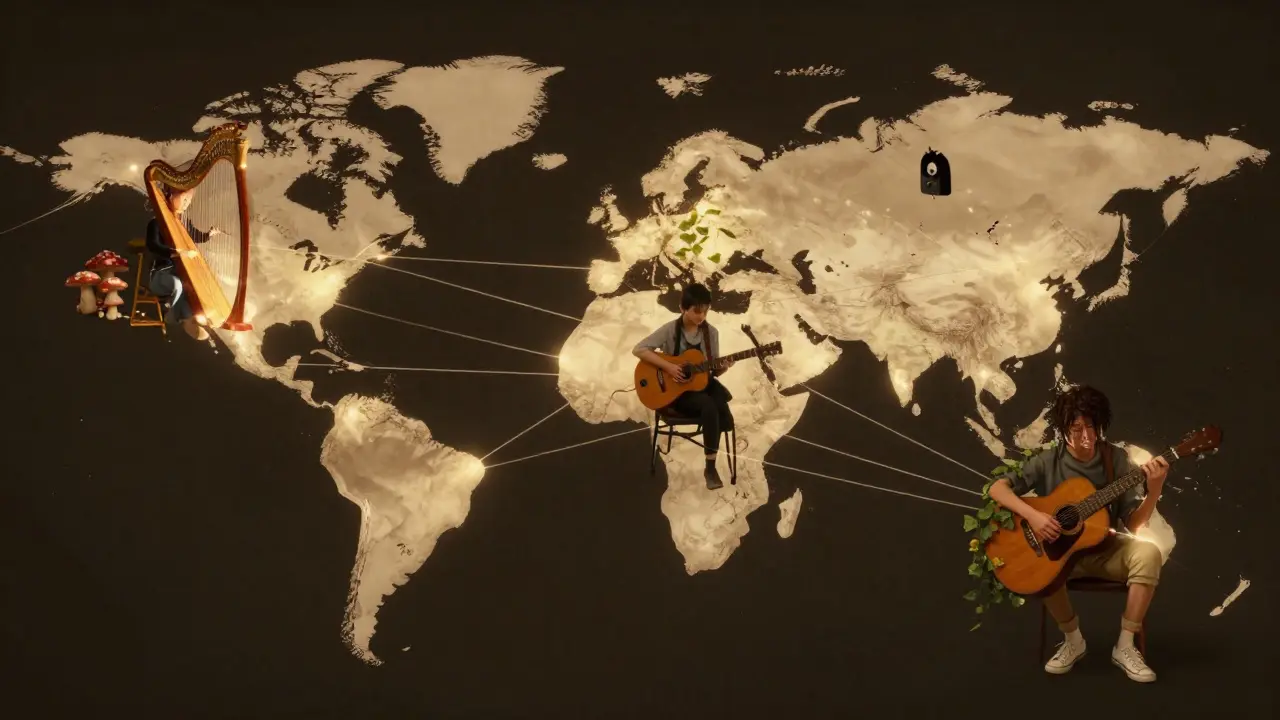
Platforms like Bandcamp and SoundCloud let artists release music without gatekeepers. That’s how ‘cottagecore’ music emerged-a soft, acoustic, nature-inspired sound with lyrics about mushrooms, tea, and old books. It didn’t come from a label. It came from teenagers in rural Japan and Germany posting lo-fi acoustic songs with hand-drawn covers. Within months, it had a global following.
Production tools also changed everything. Plugins like Valhalla VintageVerb or Waves CLA Vocals let bedroom producers replicate studio sounds. Suddenly, you didn’t need a $50,000 studio to make ‘synthwave’ music. You just needed a laptop and a dream. That’s why subgenres now form faster than ever-and die faster too. Some last a year. Others, like shoegaze, have survived for decades by constantly reinventing themselves.
Why Subgenres Matter More Than Ever
In a world where billions of songs are available, subgenres are the compass. Without them, music would be a giant, confusing blob. ‘Pop’ doesn’t tell you anything. ‘Hyperpop’ does. It tells you the song will sound like a sugar rush on a rollercoaster. ‘Post-rock’ tells you it won’t have vocals at all-but the guitars will make you cry.
Subgenres give you control. You’re not just consuming music-you’re curating your emotional landscape. When you’re stressed, you don’t just play ‘relaxing music.’ You play ‘ambient house’ with soft pads and distant vocal chops. When you need energy, you don’t just play ‘upbeat.’ You play ‘fidget house’-fast, glitchy, unpredictable.
It’s also how you find your people. Reddit threads for ‘dream pop’ fans, Discord servers for ‘mathcore’ listeners, TikTok hashtags for ‘vaporwave’ edits-these aren’t just communities. They’re tribes. You bond over shared sonic preferences that most people wouldn’t even notice.
How to Discover Your Own Subgenre Preferences
If you want to understand your own taste better, start by digging deeper than the genre labels. Instead of saying ‘I like rock,’ ask: Which kind of rock?
- Listen to playlists labeled with subgenres: ‘slowcore,’ ‘gutter punk,’ ‘kawaii metal,’ ‘neo-soul.’
- Check the ‘Fans Also Like’ section on Spotify or Bandcamp. Follow the rabbit holes.
- Read album reviews on Pitchfork or Tiny Mix Tapes-they often describe subgenres in vivid detail.
- Look at the production credits. If a producer works on a lot of ‘bedroom pop’ albums, explore those artists.
- Ask yourself: What emotion does this sound give me? Calm? Rage? Nostalgia? That’s your subgenre clue.
There’s no right or wrong. Your taste is yours. Maybe you love both ‘folk punk’ and ‘future bass.’ That’s not a contradiction-it’s a sign you’re listening deeply.
Subgenres Are Alive
They’re not stuck in the past. New ones emerge every month. In 2025, you’ll hear ‘cloud rap 2.0’-a darker, more atmospheric version of the 2010s cloud rap. You’ll hear ‘post-disco house’ blending 70s funk with modern club beats. You’ll hear ‘industrial folk’-acoustic instruments mixed with mechanical noise and distorted vocals.
Subgenres are how music stays alive. They’re how artists push forward. They’re how listeners find meaning in sound. Your favorite song isn’t just a melody. It’s a tiny revolution. And you’re part of it.
What’s the difference between a music genre and a subgenre?
A genre is a broad category like rock, hip hop, or electronic. A subgenre is a more specific style that branches off from it. For example, punk is a genre; hardcore punk, pop-punk, and post-punk are subgenres. Subgenres add unique rules-like instrumentation, tempo, or lyrical themes-that distinguish them from the parent genre.
Can one song belong to multiple subgenres?
Yes, many songs blend elements from more than one subgenre. This is called hybridization. For example, a track might combine the drum patterns of trap with the distorted guitars of metal-that’s trap metal. Or it might mix shoegaze’s reverb with black metal’s aggression-that’s blackgaze. These hybrids often become new subgenres over time.
Why do some subgenres fade while others last?
Subgenres fade when they’re tied to trends, not deep emotional or cultural needs. For example, ‘crunk’ was huge in the mid-2000s but faded as the party culture shifted. Subgenres that last-like indie rock or doom metal-offer something lasting: emotional depth, community, or sonic innovation. They adapt, they evolve, and they keep speaking to new generations.
Do subgenres have geographic roots?
Many do. Drill music started in Chicago, then took root in London with its own flavor. Grime came from East London. Emo had strong scenes in Washington, D.C., and the Midwest. Even today, local scenes shape subgenres-like how ‘cottagecore’ music exploded in Japan and Germany before going global. Place, culture, and language all influence how a subgenre sounds.
How can I find new subgenres I might like?
Start by exploring playlists labeled with specific subgenres on Spotify or YouTube. Follow artists you like and check who they collaborate with. Read music blogs like Pitchfork or Tiny Mix Tapes-they often highlight emerging sounds. And don’t ignore Bandcamp: it’s full of underground artists creating new hybrids. The best way? Listen with curiosity, not judgment.
Music doesn’t just play in the background-it shapes who you are. And subgenres? They’re the quiet architects of that identity.