
What does it mean for a musical instrument to cost more than a luxury car, a small island, or even a professional sports team? It’s not just about wood, strings, and brass. It’s about history, craftsmanship, sound that hasn’t been replicated in 300 years, and the people who’ve held them in their hands. The most expensive musical instruments in the world aren’t just tools-they’re artifacts, heirlooms, and sometimes, silent witnesses to centuries of human emotion.
Stradivarius Violins: The Gold Standard of Sound
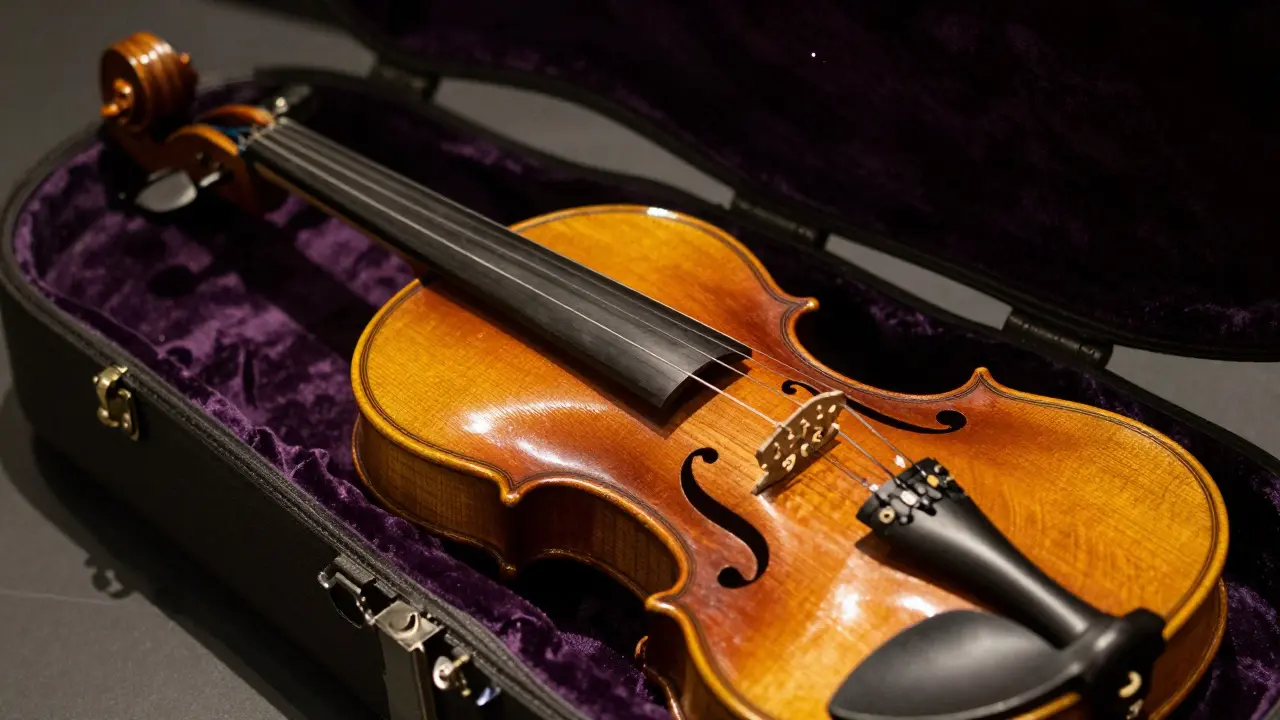
When you hear the name Stradivarius, you’re not just hearing a brand-you’re hearing the sound of perfection. Antonio Stradivari, a luthier from Cremona, Italy, built violins between 1666 and 1737. Only about 650 of his instruments survive today. Each one is hand-carved from spruce and maple, treated with unknown chemical coatings, and tuned by an ear that no modern scientist has fully decoded.
In 2011, the "Lady Blunt" Stradivarius sold for $15.9 million at auction-more than any other musical instrument in history. Why? Because it was in near-perfect condition, untouched by major repairs, and had been owned by Lady Anne Blunt, a noblewoman and granddaughter of Lord Byron. Its tone is described as warm, rich, and effortlessly powerful-even in large concert halls. Modern violins, no matter how well-made, still struggle to match the resonance of a 300-year-old Stradivarius.
These violins aren’t just played-they’re treated like sacred objects. They’re stored in climate-controlled cases, insured for tens of millions, and passed down through generations of elite musicians. The Guarneri del Gesù, another Italian maker from the same era, comes close. His 1741 "Vieuxtemps" violin sold for $16 million in 2012. The difference? Guarneri violins are known for a darker, more intense tone-perfect for soloists who want to cut through an orchestra.
The Hammer Piano: A Masterpiece of Art and Engineering
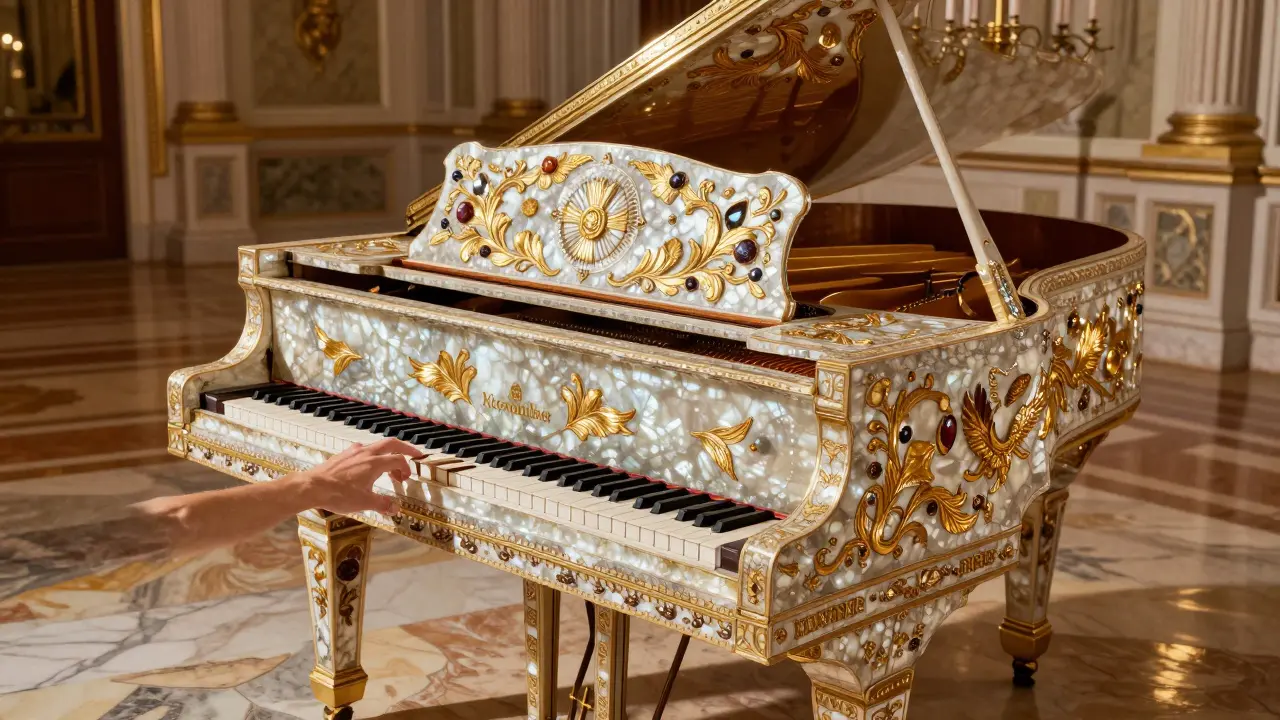
While violins dominate the high-end market, pianos can reach staggering prices too. The most expensive piano ever sold is the Hammer Piano-a one-of-a-kind instrument built by the Austrian firm Bösendorfer in 2008. It’s not just a piano; it’s a sculpture. The case is hand-inlaid with over 1,200 pieces of mother-of-pearl, gold leaf, and semi-precious stones. The keys are made from fossilized ivory, and the soundboard is carved from century-old spruce from the Tyrolean Alps.
This piano was commissioned by a Middle Eastern royal family and took three years to complete. It cost $2.7 million. But the real value isn’t in the materials-it’s in the sound. The Hammer Piano has 10 extra bass keys, extending its range to 97 notes instead of the standard 88. The resonance is so deep, so full, that it vibrates the floor. Pianists who’ve played it say it feels like the instrument is breathing with them.
Other high-end pianos like the Steinway & Sons Model D, used by Lang Lang and Martha Argerich, sell for $180,000 new. But even these pale next to custom-built masterpieces. The Fazioli F308, made in Italy, costs around $200,000 and is prized for its clarity and dynamic range. Still, none carry the mystique of the Hammer Piano.
The Guo Nian: China’s Answer to the Stradivarius
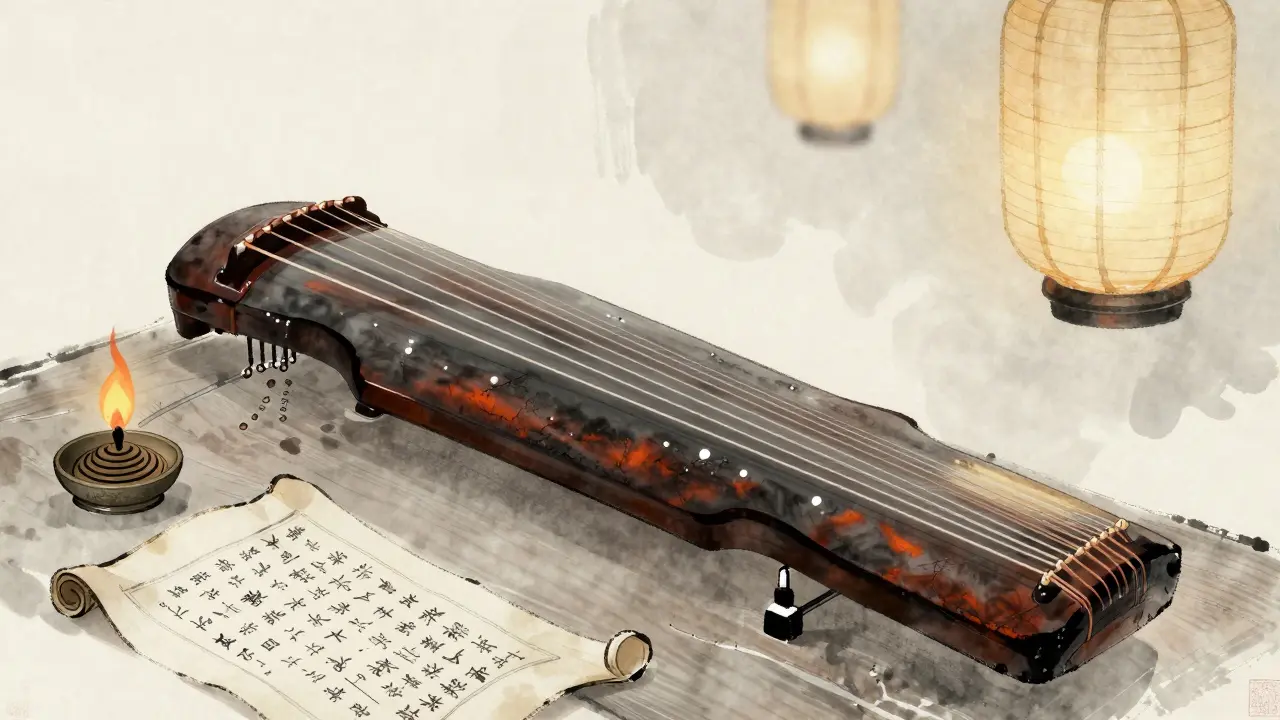
Most people think of violins and pianos when they think of expensive instruments. But in China, the guqin-a seven-stringed zither dating back over 3,000 years-holds equal reverence. The most valuable guqin ever sold was the Guo Nian, a Tang Dynasty instrument from the 8th century. It was carved from ancient tung wood and inlaid with jade and mother-of-pearl. Its surface showed the famous "crackled" finish known as "frosting," formed by centuries of playing and aging.
In 2010, the Guo Nian was auctioned in Hong Kong for $12.5 million. It had been hidden for decades during the Cultural Revolution, passed secretly from scholar to scholar. Unlike Western instruments, the guqin isn’t about volume or projection. It’s about subtlety-the whisper of a plucked string, the lingering echo, the silence between notes. Confucius himself is said to have played it. Today, only about 20 Tang Dynasty guqins remain, and each is considered a national treasure.
Modern guqins made by master craftsmen can cost $50,000 or more. But the Guo Nian isn’t just a musical instrument-it’s a link to China’s philosophical and poetic heritage. To play it is to enter a tradition where music is meditation.
The 1721 Paganini Violin: A Curse and a Crown
Not every expensive instrument is expensive because of its sound. Sometimes, it’s because of its story. The 1721 violin known as the "Paganini"-officially the "Cannon"-was played by the legendary Italian violinist Niccolò Paganini. He claimed the instrument was cursed: every owner after him suffered misfortune. One violinist went blind; another died in a carriage accident.
Regardless of the curse, the sound was undeniable. Paganini used it to perform his most difficult compositions-pieces so technically demanding they were thought impossible. The violin’s body was slightly larger than standard, with a deeper, more resonant voice. After Paganini’s death, it was locked away for decades. When it resurfaced in 1998, it sold for $6 million.
Today, it’s owned by the city of Genoa, Italy, and only played once a year during a special concert. The musician who plays it is chosen by committee. No one is allowed to record it. The sound is considered too sacred to be reproduced.
Why Do These Instruments Cost So Much?
It’s easy to think these prices are just about rarity. But it’s deeper than that. These instruments are the result of:
- Unrepeatable craftsmanship-no two Stradivarius violins are alike, and no modern maker has replicated the exact wood treatment or varnish.
- Historical provenance-who owned it? Who played it? Was it part of a royal collection? A famous concert?
- Sound quality-musicians swear these instruments have a presence you can’t find in modern copies. Even blind tests show they’re preferred in tone and projection.
- Cultural weight-a guqin isn’t just an instrument; it’s a symbol of ancient Chinese philosophy. A Stradivarius is tied to the birth of Western classical music.
There’s also the market factor. Wealthy collectors, museums, and governments treat these instruments like fine art. They’re bought as investments. Some are held in trusts. Others are loaned to top musicians under strict conditions.
Can You Buy a Modern Instrument That Comes Close?
Yes-but not for the same price. Modern luthiers like Stefan-Peter Greiner, Sam Zygmuntowicz, and Mattias Johansson make violins that sell for $100,000 to $300,000. They use CT scans of Stradivarius violins, advanced wood treatments, and years of testing. Some even match Strads in blind tests.
But they still don’t carry the aura. A modern violin can sound amazing. But it won’t have been played by a genius in a 17th-century palace. It won’t have survived wars, revolutions, and centuries of changing tastes. That’s the real cost.
What Happens to These Instruments Today?
Most are locked in museums, banks, or private vaults. Some are loaned to top performers under strict conditions. The "Lady Blunt" Stradivarius is now in the hands of a private foundation that loans it to young virtuosos. The Guo Nian is displayed in a climate-controlled case in Beijing, with only three musicians ever granted permission to play it in the last 20 years.
For most musicians, these instruments are out of reach. But their existence changes how we think about music. They remind us that sound isn’t just physics-it’s memory, culture, and soul.
Why are Stradivarius violins so much more expensive than other violins?
Stradivarius violins are more expensive because of their unique craftsmanship, historical significance, and unmatched sound quality. Antonio Stradivari used wood treated with unknown chemical formulas, and his carving techniques have never been fully replicated. Only about 650 survive, and their tone-described as rich, warm, and powerful-is still preferred by top violinists. Their provenance, including ownership by royalty and legendary musicians, adds to their value.
Is it possible to buy a modern violin that sounds as good as a Stradivarius?
Yes, modern luthiers have created violins that match or even surpass Stradivarius violins in blind sound tests. Craftsmen like Sam Zygmuntowicz and Stefan-Peter Greiner use CT scans of original Strads, advanced wood treatments, and decades of experience. Some cost up to $300,000. But while they may sound similar, they lack the centuries of history and cultural weight that make a Stradivarius priceless.
What’s the most expensive musical instrument ever sold?
The most expensive musical instrument ever sold is the "Lady Blunt" Stradivarius violin, which auctioned for $15.9 million in 2011. It was in near-perfect condition, untouched by major repairs, and had been owned by Lady Anne Blunt, a noblewoman with ties to Lord Byron. The next highest was the "Vieuxtemps" Guarneri violin, which sold for $16 million in 2012.
Why do people pay millions for instruments that can’t be played often?
These instruments are treated like cultural relics. Their value isn’t just in sound-it’s in history, rarity, and legacy. Many are owned by foundations, museums, or governments that loan them to top musicians under strict conditions. Playing them too often risks damage, so they’re often stored in climate-controlled environments. Their rarity and connection to musical legends make them more valuable as symbols than as tools.
Are there any expensive instruments from outside Europe?
Yes. The Chinese guqin, especially ancient ones like the Tang Dynasty Guo Nian, are among the most valuable. The Guo Nian sold for $12.5 million in 2010. These instruments are deeply tied to Chinese philosophy and poetry. Other examples include rare Japanese koto and Indian sitars owned by royal families or master musicians, though few have reached the price of European instruments due to different collecting markets.